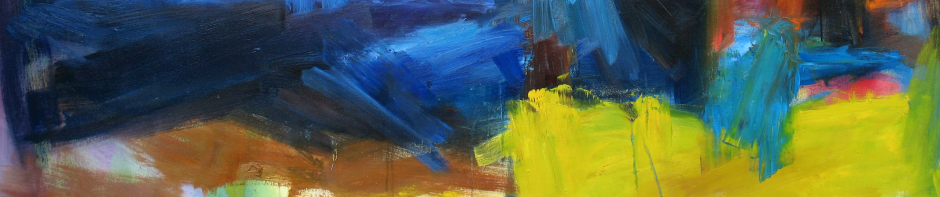
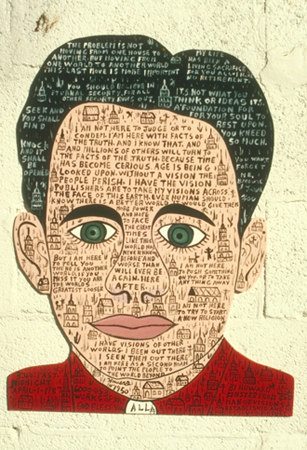
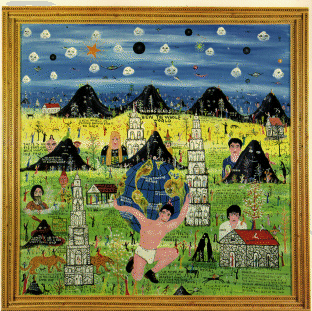
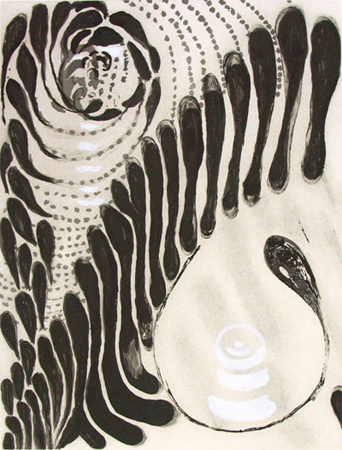
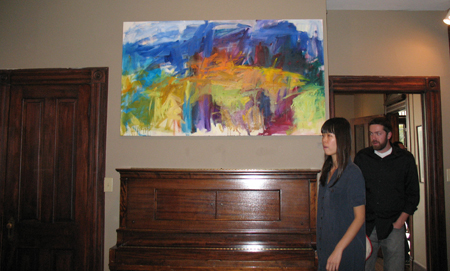
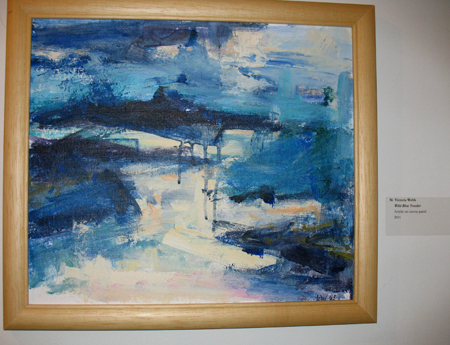
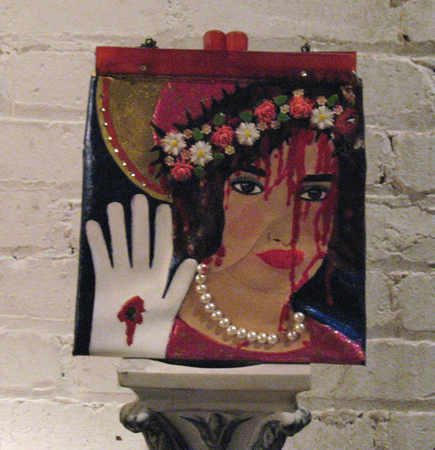
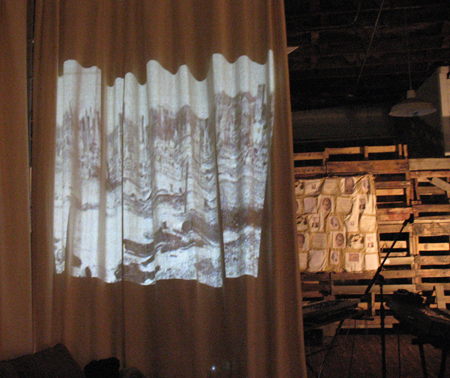
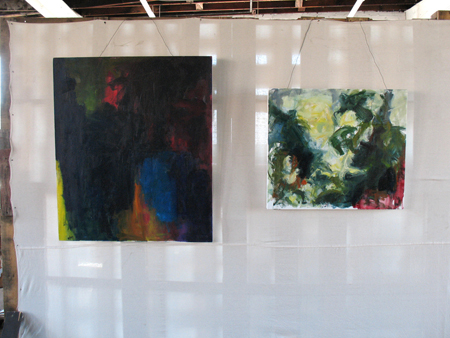
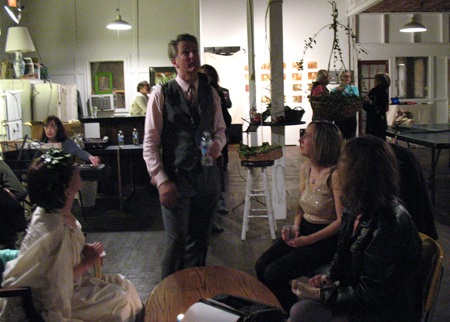
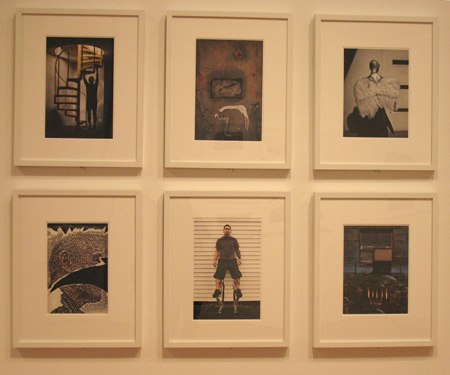
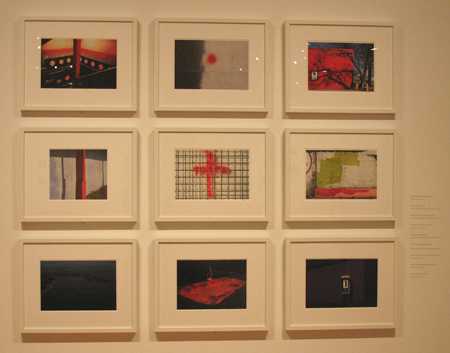
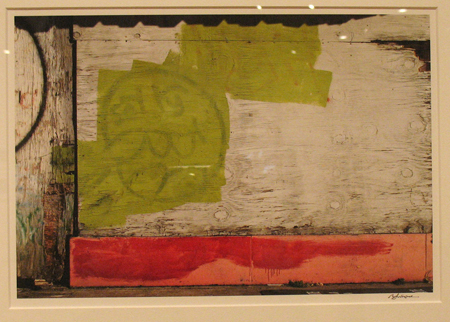
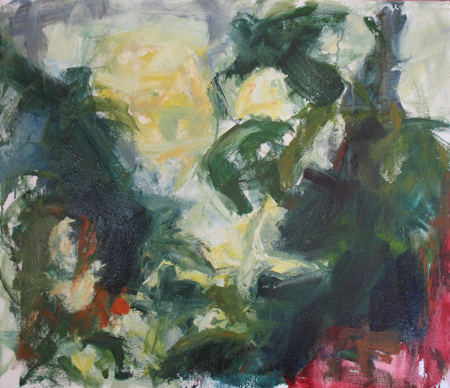
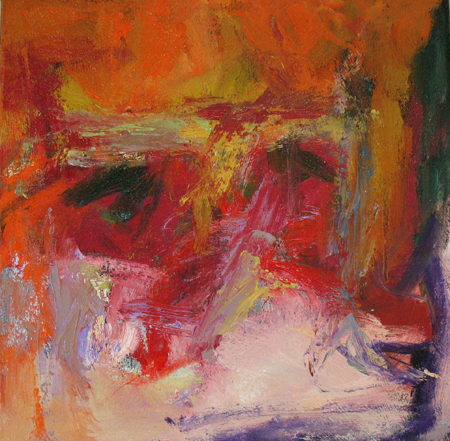
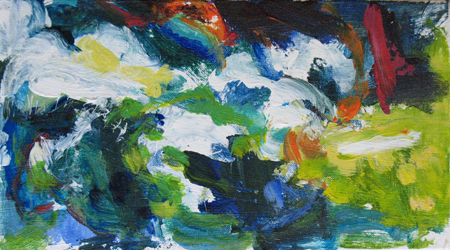
A few new paintings from October and November. I’ll be showing work at the Paideia School’s Art Visions annual fundraiser this weekend, November 19/20 and at the Telephone Factory lofts on December 3/4.
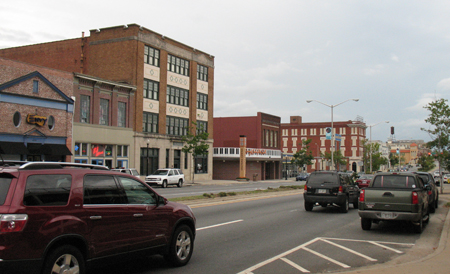
Rockbridge Road. Acrylic on canvas panel, 16″ x 20″, 2011.
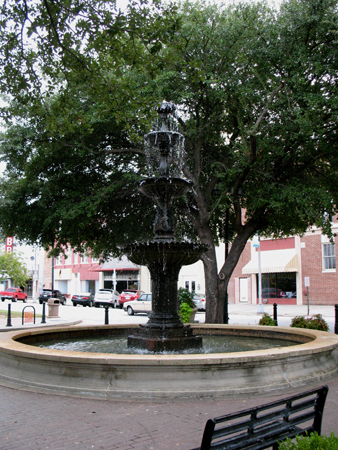
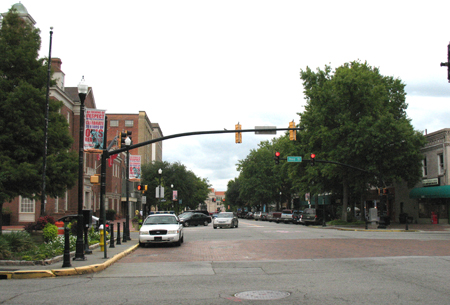
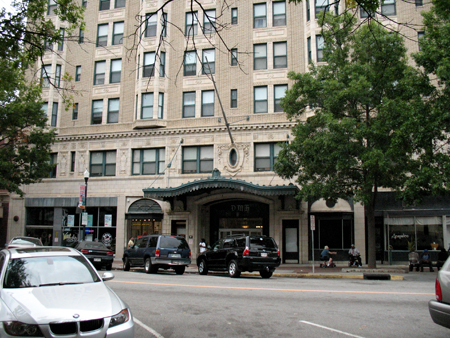
Avondale, November 13. Oil on canvas, 35″ x 26″, 2011.
I attended part of a symposium yesterday at Emory’s Michael C. Carlos museum called “The Somewhere Summit, Connecting the Local to the Global in Atlanta Art”. In conjunction with Atlanta Art Now’s 2011 publication, Noplaceness: Art in a Post-Urban Landscape, the summit noted that it would “specifically discuss two related questions: How are artists redefining the idea of place and locality as these concepts shift in an era of rapid geographic, demographic and technological changes, and what does that mean for how Atlanta artists relate to the rest of the world?”
The hour long panel talk that I saw featured Anne Collins-Smith, Curator of Collections at the Spelman College Museum of Fine Art; Diana McClintock, Professor of Art History at Kennesaw State University and writer for Art Papers; and Qi Wang, Assistant Professor of Literature, Communication and Culture at Georgia Institute of Technology. It was moderated by Ayokunie Odeleye, a sculptor and arts educator. In depth bios here.
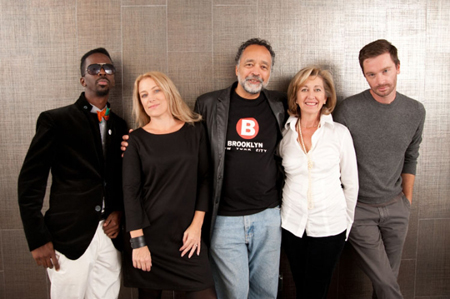
Photo courtesy LuxeCrush‘s article on Noplaceness. Some of the locally based artists mentioned in the book include Fahamu Pecou, Danielle Roney, Arturo Lindsay, Rocio Rodriguez and Jody Fausett – all shown above.
Luxe notes in the article that the book is “The brainchild of local arts patron Louis Corrigan and his Possible Futures foundation, Noplaceness is a seriously academic book of essays crafted by three noted Atlanta-based art critics—Cinque Hicks of Creative Loafing and Creative Director of Atlanta Art Now, Jerry Cullum, the Atlanta correspondent for Art News and long-time contributor to Art Papers, and co-founder of ArtsCriticATL.com and past art and architecture critic at The AJC Catherine Fox.”
As we walked in, there were reading resource handouts for each panel discussion at the reception desk. I’ll include a few and a couple of my own finds at the end of the post.
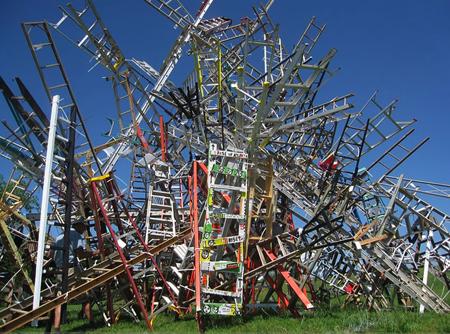
Flux Film 010: Rise Up Atlanta. Charlie Brouwer’s large-scale sculpture of ladders lent by Atlanta residents. Watch the clip, it’s charming and poignant. And the site is near where I used to live off Williams Mill Rd, a block from Manual’s Tavern. I just discovered that Charlie  has a studio in Floyd County, VA near where my maternal grandfather was born and grew up. That coincidence demands a visit!
Diana McClintock spoke about Michel Foucault’s ‘relationship of sight’ and said that this is the era of space. Everything is local and global at the same time. “The space in which we live, which draws us out of ourselves….we live inside a set of relations that delineates sites which are irreducible to one another and absolutely not superimposable on one another.” – Of Other Spaces, Heterotopias (1967), by Michel Foucault.
The internet allows for greater access, but she questioned whether it makes local more significant. Does making a place hard to get to – such as bigger and more urban cities – make them more important? She also asked whether the vernacular belongs in higher academic venues. In other words, does Howard Finster’s work remain in the vernacular because his Paradise Garden is based in Summerville, Georgia? Or does his work become universal as it expands its range, which is the goal of all artists.
Lisa  Tuttle, a longtime artist on the Atlanta scene and whom I bumped into at the symposium, asked similar questions in her article on Burnaway earlier this October. A few of them were, “Does the art we make ultimately matter, and does it matter over time? And, if so, to whom?….what connects us and what divides us?”
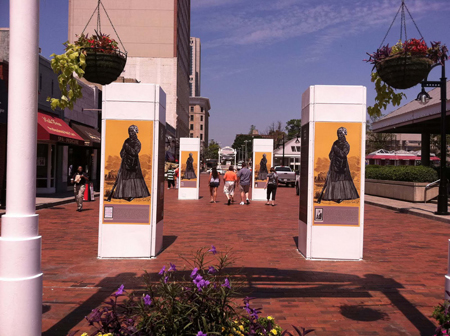
Tuttle’s art installations often include poetry and reference the local community. Her recent collaboration with writer and activist Alice Lovelace produced a temporary public art project titled Harriet Rising, presented this summer by the Atlanta Office of Cultural Affairs and situated above Underground, Atlanta.
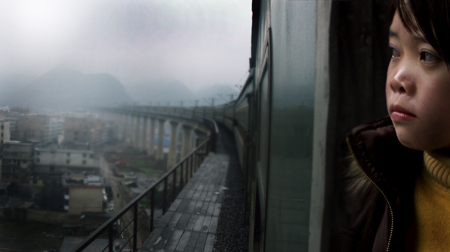
Qi Wang noted that in China, documentary filmmakers are engaging communities in rural villages and emphasizing a connection between the local and social fabric of the regions. A major phenomenon is documented in the film by Chinese-Canadian director Lixin Fan, Last Train Home, in which workers are having to leave their villages to go to urban areas in order to make a living. Are they bringing their customs and art to the urban areas or vice versa?
Zhang Qin in Last Train Home.
Ann Collins-Smith suggested that she forges relationships with artists that extend her own ‘local’ boundaries. Both she and McClintock associated authenticity as a benefit of being locally based, the idea that genuine experience can capture an audience’s attention, existing outside the larger world.
The term global seems to offer many benefits to the artist in terms of more access, a wider scope of available patrons and the ability to go beyond one’s ‘rootedness’. However, the panel agreed that a foundation tied to place may be as important as the notion of fluidity. Qi Wang brought the Buddhist notion of everyday being unfixed into the mix, and the fact that borders are being crossed continually – both literally and metaphorically.
One audience member suggested that the challenge is that global art needs to create local art, and is already doing this by appropriating language and popular Western themes in the work. If the majority of local art is being redefined by Western language and thought, what does that say to us about discrete space or place or cultural distinctions? Artists cross all sorts of perceived, moral and real boundaries, yet they may still focus on a connection to their roots.
Shirazeh Houshiary (Iranian, b. 1955) Image of Heart, 1991. Courtesy Lisson Gallery, London & the artist.
Another question is whether there is, or will evolve, a backlash against more conventional and established art markets. Do communities who support the arts resist inflated pricing (as with the housing market) and will they subsequently focus that support on their immediate region? If like the local farm and food movements, we can similarly build local arts movements, is that necessarily bad or limiting? It doesn’t automatically remove the artist from her larger environment; artists will always seek out other artists and to paraphrase Malraux, each carries the whole of art history on her back.
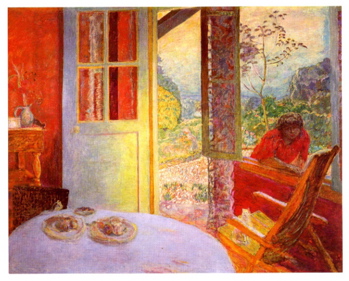
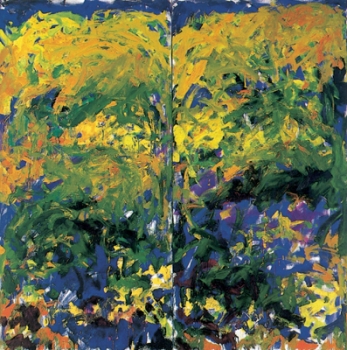
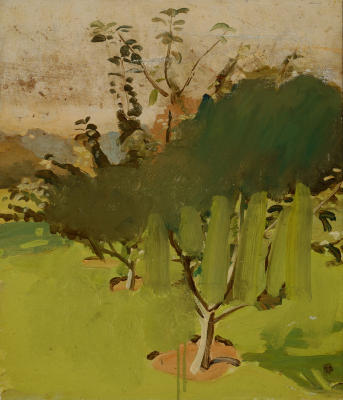
The artist needs it all; the global, interactive and social networking and the local, to survive in the current economy. The panel debate was relatively theoretical, but in practice there have always been artists who remained stubbornly local. Bonnard comes to mind, an artist who painted from views out windows overlooking his backyard wherever he lived. Fairfield Porter painted, wrote criticism and stuck to his Maine and Southampton, NY environs. Despite the ease of modern travel, contemporary painters have long used place (the Hamptons, Provincetown, Paris) as their specific foundation and inspiration. Is Joan Mitchell less known because she sequestered herself away outside Paris and never returned to the US to live? Probably not.
Fairfield Porter, Apple Trees, circa 1950. Courtesy the Parrish Art Museum, Southampton, NY.
In her book On Curating: Interviews with Ten International Curators, Carolee Thea states that “Today, artists in the globalized art scene have been repeating a diverse and politically correct discourse about the disappearance of borders and trans-cultural crossovers. Some have experienced voluntary or forced economic or political migration.
…It is not enough for contemporary art to become a spectacle embraced by cities and people in all corners of the world. What matters more is that artists and communities are sharing information and mingling cultures at a rapid pace, reinventing themselves through these interactions and through a renewed engagement with the commonalities of everyday life. Cyber-communications and technological innovations may be accelerating these transmutations, but where they will lead continues to unfold before our eyes.”
Ms. Thea’s 2006 premise that the curator as a mediator is now more necessary than ever before  to “provide a context to enable the public’s understanding” of art may be already outdated. From my own experience (or migration) through promoting work online, I have found patronage both locally and globally. In discussions on various blogs with other artists and in artist coordinated alternative space exhibits, there appears to be a paradigm shift away from the traditional market of the gallerist or curator as middle man, and the evolution (or return) of the artist interacting directly with her supporters. While the experience may not always be situated in a physically local space, the interaction is intimate. That ‘exchange’ is unique to this era and will continue to evolve as technology changes our lives.
Atlanta galleries and museums here.  Recommended readings include:
Article by Maryam Ekhtiar, Department of Islamic Art, The Metropolitan Museum of Art  and Marika Sardar, Institute of Fine Arts, New York University
on Modern and Contemporary Art in Iran.
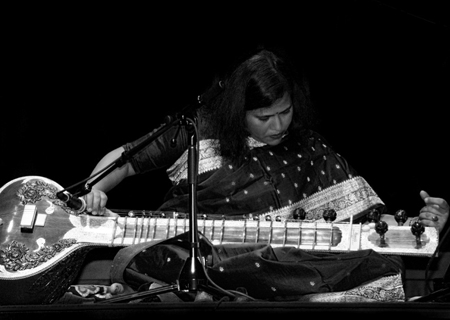
This past friday evening I saw Dr. Kakali Bandyopadhyay on sitar and Anjaneya Sastry on tabla at the Schwartz Center. Both are fantastic musicians and it was a free program. Bandyopadhyay, who has been playing for twenty years, teaches sitar and North Indian classical music at Emory. Her training included classes with Ravi Shankar and Ali Akbar Khan. Sastry has trained with the world-renowned Ustaad Zakir Hussein and regularly performs traditional tabla solo concerts. For a more in depth review of a previous concert by the duo, see this article from 2009.
The Schwartz Center is a gem of a building, with no bad seats to be had in Emerson’s state of the art hall. All performances are open to the public and many are free.
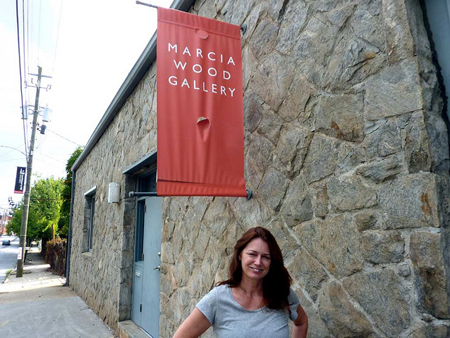
Saturday I headed down to the Marcia Wood gallery near Castleberry (a block away from Pillowtex) for an artist’s talk by Kate Javens and to check out the space. Even though it’s just a few steps away from the other arts district, it’s a bit lonely on the block but has a wonderful terrace out back.
Terry Kearns conducted a 2010 gallery-palooza, visiting 35Â spaces in a 12 hr marathon. Here’s his photo of Wood in front of the entrance to her gallery. I took no photos, sorry.
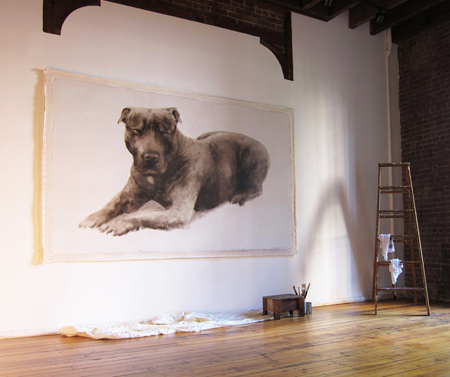
Javens lives in NYC and uses theatrical muslin for her canvases of animals. She works from ‘fresh kill’ bodies and has studied how to wire them for positions and how to best protect herself from pathogens. I was reminded of a modern Audubon, albeit one using monochromatic color. Photo courtesy gallery.
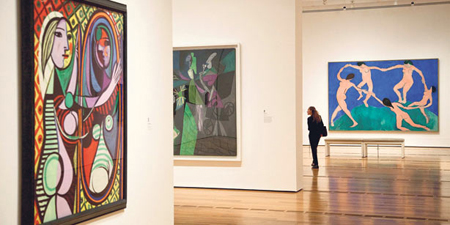
Afterwards I hit the High Museum for their current blockbuster on loan from MOMA, Picasso to Warhol. No photographs allowed except with cell phones. Here are a few highlights and a recent review on Burnaway.
Picasso’s Girl Before a Mirror, and Henri Matisse’s Dance. (Photo: AP)
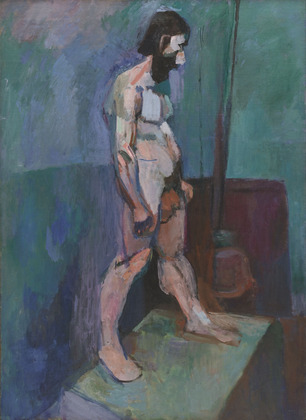
Henri Matisse, Male Model. Paris, c 1900. Photo MOMA.
I’m not fond of viewing paintings in the mad crush of people running through museum galleries with headphones on, so I’ll have to return. The Matisses are stand outs, as were some early Picassos. Louise Bourgeois was represented with a few small sculptures and several drawings/etchings, but she’s the only woman in the entire exhibit.
Louise Bourgeois, Untitled, 1994. Intaglio, edition of 65. Photo Barbara Krakow gallery.
I sat through the first part of a lecture in Robinson atrium at the High, comparing Van Gogh and Pollock, given by co-authors of the books, Van Gogh, The Life and the 1990Â Jackson Pollock: An American Saga. That book was the basis for the film made about the artist, starring Ed Harris in 2000.
The authors Steven Naifeh and Gregory White Smith propose that Van Gogh was a voracious reader while Pollock read only one book in his lifetime; Melville’s Moby Dick. An early New York Times review refutes some of the authors’ sketchy claims. And Henry Adams, one of the leading scholars on Pollock, has a more realistic and informed view of the artist’s intellectual life.
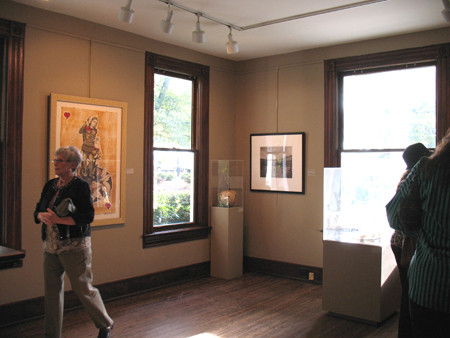
Sunday was the opening and juror’s talk at the Douglasville Cultural Arts Center, a historic late Victorian built in 1901, managed by Executive Director Laura Lieberman. Lieberman was one of the original editors of Art Papers, a local arts publication founded in 1979 by Dan Talley, and still in print. Several reviews of my past exhibits in Atlanta were featured in the magazine during the 1980s.
Angela Nichols of the Hudgens Center, curated the show. The crowd enjoyed a spread provided by the Douglasville Art Guild.  Two of my paintings were featured.
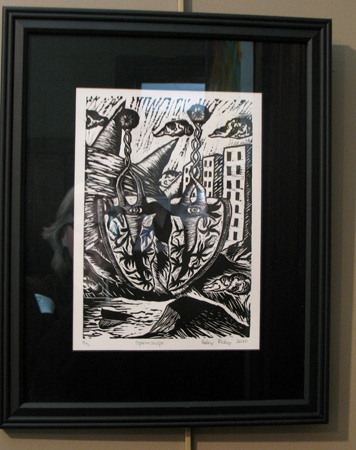
43 artists were accepted into the 25th National Juried Exhibition. My favorite pieces in the show were a couple of the woodcuts and this Deruta style ceramic skateboard. These outlying cultural centers around Atlanta seem to get quite a response to their exhibits.
I had a scare last week with six retinal tears in one eye that required emergency laser surgery. These occurred after posterior vitreous detachments (PVD’s) in both eyes during the summer and fall. Lucky for me that the Emory Eye Clinic is nearby. By chance (because you’re usually assigned whomever is on duty), I had a great doctor, G. Baker Hubbard III, who whisked me into the operating room that afternoon. He may sound like one of the cast members of Gilligan’s Island, but he’s a veteran retinal specialist with pedigrees from Vanderbilt and Emory.
What causes PVD’s? If you’re young and box or play heavy contact sports, a trauma can precipitate the vitreous fluid detaching and creating floaters or worse, tears of the retina or retinal detachment. If you’re between 40 and 70, they’re apparently a common plight.
After the surgery I was forbidden to read, paint, email or swim for a week. All the things I normally do. What was left, daytime TV? Nah, I took the week to brush up my culinary skills.
Not everyone loves spicy hot chili, curried cauliflower or gingery gingersnaps…but since I was the one commandeering the kitchen, those were my choices. The black bean chili recipe is from Green’s – the restaurant is on San Francisco’s Fort Mason marina overlooking the water. The gingersnaps are from an old Gourmet whose pages are tattered from Christmas baking. And the cauliflower dish is from the 1971 first printing of the New York Times Natural Foods cookbook, by Jean Hewitt. My ex mother-in-law gave me that one and it’s practically falling apart.
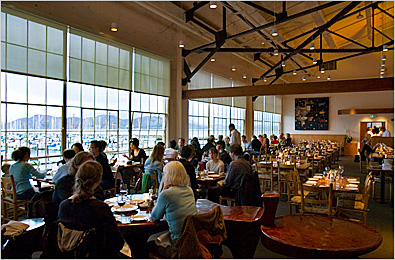
Greens was one of my favorite restaurants when I lived in San Francisco. Vegetarian based meals with organic produce from the Green Gulch farm in Marin were simple, incredibly tasty and healthy. Not to mention the great view from the dining-room.
My sister gave me the 1987 cookbook, written by founding chef Deborah Madison and the Tassajara Bread Book’s author Edward Espe Brown. That little 1970 volume is somewhere up in the attic. It inspired an autumn spent in Easton, PA selling loaves of dense, hand milled organic wheat bread on the town square. $3 a loaf in 1970 was thought to be exorbitant, but we had takers! Now of course, that’s at the low end for the price of organic bread.
I substituted pinto beans for 1 c. of the black beans in the chili and got a denser soupy mixture. If you’re using ground chili instead of roasting your own peppers, try 1 Tbs at a time and taste. My 1 Tbs of Dekalb Farmers Market chipotle and 1 Tbs of chili powders is a pretty intense heat.
Serve with cornbread or over brown rice.
BLACK BEAN CHILI
2 cup Black turtle beans
1 Bay leaf
4 tsp Cumin seeds
4 tsp Dried oregano leaves
4 tsp Paprika
1/2 tsp Cayenne pepper
1 Chile negro or ancho chile, (for chili powder)
or 2 TB Chili powder, or more
3 TB Corn or peanut oil
3 med Yellow onions – diced into 1/4-in squares
4 Garlic cloves – coarsely chopped
1/2 tsp Salt
1 1/2 lb Ripe or canned tomatoes -peeled, seeded and chopped- juice reserved
1 TB Rice wine vinegar (or more)
4 TB Cilantro, chopped
GARNISHES
Green chiles: 2 Poblano or Anaheim, – roasted, peeled & diced
or 2 oz Canned green chiles, – rinsed well and diced
1/2 cup Grated Muenster cheese – (or more)
1/2 cup Creme fraiche or sour cream
Cilantro
SORT THROUGH THE BEANS and remove any small stones. Rinse them well, cover them generously with water, and let them soak overnight. Next day, drain the beans, cover them with fresh water by a couple of inches and bring them to a boil with the bay leaf. Lower the heat and let the beans simmer while you prepare the rest of the ingredients. (Or pressure cook as I do).
Heat a small heavy skillet over medium heat. Add the cumin seeds, and when they begin to color, add the oregano leaves, shaking the pan frequently so the herbs don’t scorch. As soon as the fragrance is strong and robust, remove the pan from the heat and add the paprika and the cayenne. Give everything a quick stir; then remove from the pan–the paprika and the cayenne only need a few seconds to toast. Grind in a mortar or a spice mill to make a coarse powder.
Preheat the oven to 375ºF. To make the chili powder, put the dried chile in the oven for 3-to-5 minutes to dry it out. Cool it briefly; then remove the stem, seeds and veins. Tear the pod into small pieces and grind it into a powder in a blender or a spice mill. (Or use powders chile, we have lots available here)
Heat the oil in a large skillet and saute the onions over medium heat until they soften. Add the garlic, salt and the ground herbs and chili powder and cook another 5 minutes. Add the tomatoes and their juice. Simmer everything together for 15 minutes then add this mixture to the beans, and, if necessary, enough water so the beans are covered by at least 1-inch.
Continue cooking the beans slowly until they are soft, an hour or longer, or pressure cook them for 30 minutes at 15 pounds pressure. Keep an eye on the water level and add more, if needed, to keep the beans amply covered. When the beans are cooked, taste them and season to taste with the vinegar,
additional salt if needed, and the chopped cilantro.
Prepare the garnishes. If you are using fresh green chiles, roast them over a flame until they are evenly charred. Let them steam 10 minutes in a bowl covered with a dish; then scrape off the skins, discard the seeds, and dice. Serve the chili ladled over a large spoonful of grated cheese and garnish it with the creme fraiche or sour cream, the green chilies and a sprig of fresh cilantro.
Though served in a bowl and eaten with a spoon, this chili is a great deal thicker than most soups–thick enough in fact to be served on a plate right alongside fritters or cornbread. It also, however, can be thinned considerably with stock, water or tomato juice to make a thinner but still very flavorful black bean soup. When thinned to make a soup, it can be served as part of a meal rather than a meal in itself.
I couldn’t find a recipe that matched Hewitt’s cauliflower curry, but this one comes close and is a bit heartier with the addition of potatoes. She included 3/4 tsp grated fresh ginger. It’s a main meal served with rice.
Potato and Cauliflower Curry Serves 4-6
1 large or 2 small onions, diced small
1 pound (about 6 small) red potatoes, cut into small cubes
1 small head of cauliflower, cut into bite-sized pieces
1-inch nub of garlic, minced or grated on a microplane
1 teaspoon cumin
2 teaspoons curry powder
1/4 teaspoon turmeric
1 (28-ounce) can diced tomatoes in their juices
3/4 tsp grated fresh ginger.
1 c. yogurt
Heat a teaspoon of olive oil in a 4- to 6- quart dutch oven over medium-high heat. Cook the onions with a half teaspoon of salt until they are soft and translucent. Add the potatoes with another half teaspoon of salt and cook until they are browned on all sides. Add the cauliflower and cook until it is also browned in spots.
Toss in all of the spices and stir until they are fragrant, about 30 seconds. Pour in the tomatoes and their juices. Bring everything to a boil, then reduce the heat to medium-low. Cover the pot and let the curry simmer until the potatoes and cauliflower are soft, 15-20 minutes. For a thicker sauce, remove the lid in the last five minutes of cooking to let moisture evaporate.
Turn off the heat and stir in the yogurt. Taste the curry and adjust the salt, pepper, or other seasonings as desired. This curry will keep for one week refrigerated or up to 6 months frozen. (If you’re planning on freezing some of it, don’t add the yogurt until you’re ready to serve the curry.)
Ginger Snaps
Makes 40-50 cookies
2 cups flour
1½ teaspoons baking soda
1/4 teaspoon salt
1 1/2 teaspoons ground cinnamon
1/2 tsp cloves
1/2 tsp ground cardamom
1 1/2 tsp freshly grated lemon rind (optional)
1 or 2 teaspoons ground ginger, depending on how much you like ginger
1/2 c. of candied ginger, chopped finely.
1 stick (1/2c) butter, unsalted, at room temperature
2/3 cup firmly packed brown sugar
3 Tbs unsulfured molasses
1 large egg
coarse sugar crystals for coating the cookies
1. Stir together the dry ingredients.
2. In the bowl of an electric mixer, or by hand, beat the butter just until soft and fluffy. Add the sugar and continue to beat until smooth, stopping the mixer to scrape down any butter clinging to the sides of the bowl.
3. Stir in the molasses and egg.
4. Mix in the dry ingredients gradually until the dough is smooth.
5. Divide the dough in two equal portions and roll each on a lightly-floured surface until each is about 2-inches around.
6. Wrap each in plastic wrap then roll them lightly on the counter to smooth them out. Refrigerate, or better yet, freeze the cookie logs until firm.
7. To bake, preheat the oven to 350F and line two baking sheets with parchment paper.
8. Slice cookie dough into 1/4-inch rounds with a sharp knife. Dip one side and press firmly in a bowl of coarse sugar if you want (you can also use granulated sugar instead), and place sugar-side up on baking sheet, evenly-spaced apart. Leave a couple of inches between cookies since they’ll spread while baking.
9. Bake for 10-14 minutes, rotating the baking sheets midway during baking, until deep-golden brown. The cookies will puff up a bit while baking, then settle down when they’re done. Bake on the lower end of the range for softer cookies, and more for snappier ones, depending on your oven.
10. Let the cookies cool two minutes, then remove them with a spatula and transfer them to a cooling rack.
Storage: The dough can be refrigerated for up to five days, or frozen for up to three months. Once baked, the cookies can be kept in an air-tight container for a couple of days.
I used to roll out these cookies into stars, Christmas trees and animals. But making the logs, then freezing and slicing is a lot easier.
As an extra, my favorite brownie recipe of all time, picked up off David Lebovitz’s blog from  Nick Malgieri’s book Chocolate: From Simple Cookies to Extravagant Showstoppers (HarperCollins, 1998). I always add 1 c. of organic chopped walnuts to the mix and for the chocolate, my preference used to be the San Francisco based Sharffen Berger. That company, along with two other great chocolatiers; Joseph Schmidt and Dagoba, were  acquired by Hershey about five years ago. Sniff.
16 tbsp. unsalted butter,
plus more for greasing
8 oz. bittersweet chocolate,
cut into 1â„4″ pieces
4 eggs
1 cup sugar
1 cup firmly packed dark brown
sugar
2 tsp. vanilla extract
1â„2 tsp. fine salt
1 cup flour
1 cup organic walnuts, chopped
1. Heat oven to 350°. Grease a 9″ x 13″ baking pan with butter and line with parchment paper; grease paper. Set pan aside.
2. Pour enough water into a 4-quart saucepan that it reaches a depth of 1″. Bring to a boil; reduce heat to low. Combine butter and chocolate in a medium bowl; set bowl over saucepan. Cook, stirring, until melted and smooth, about 5 minutes. Remove from heat; set aside.
3. Whisk together eggs in a large bowl. Add sugar, brown sugar, vanilla, and salt; whisk to combine. Stir in chocolate mixture; fold in flour. Pour batter into prepared pan; spread evenly. Bake until a toothpick inserted into center comes out clean, 30–35 minutes. Let cool on a rack. Cut and serve.
MAKES 24 BROWNIES
Try a good red wine with the brownies or better yet, a small glass of Gourmel’s Age Des Epices organic cognac to welcome in winter’s chill.
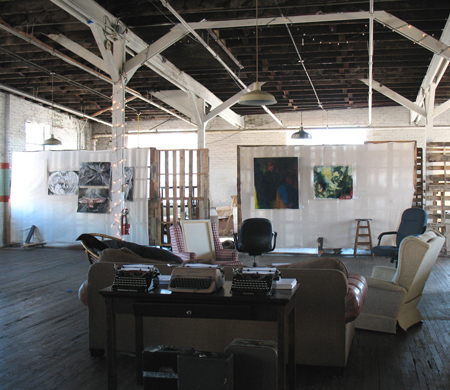
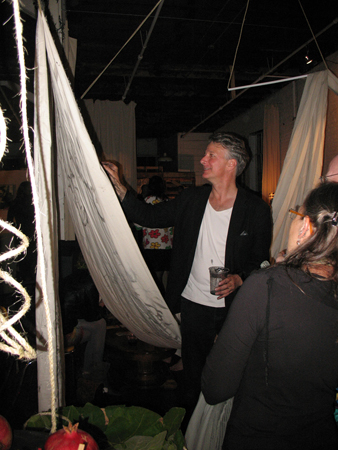
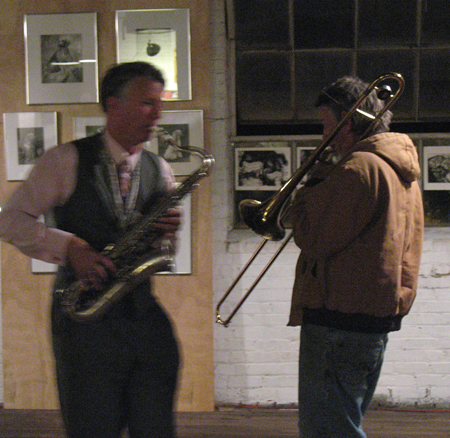
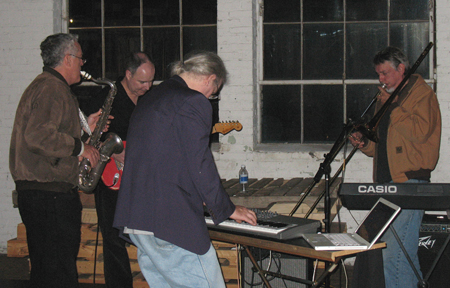
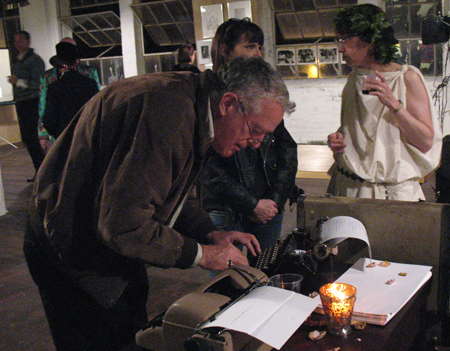
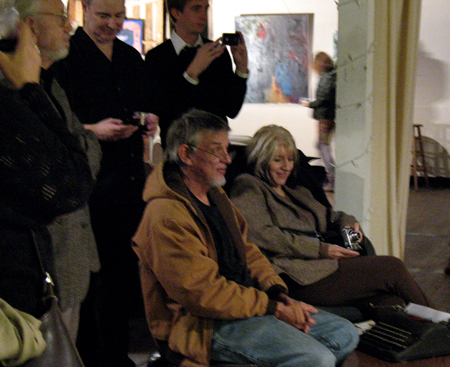
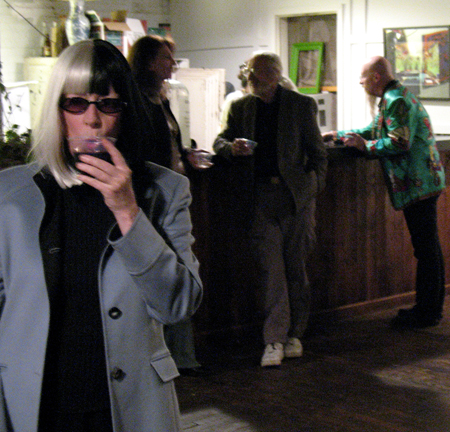
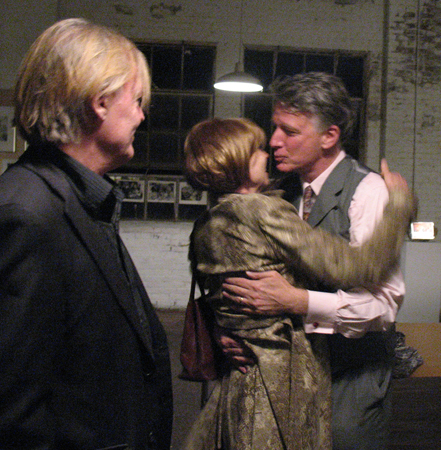
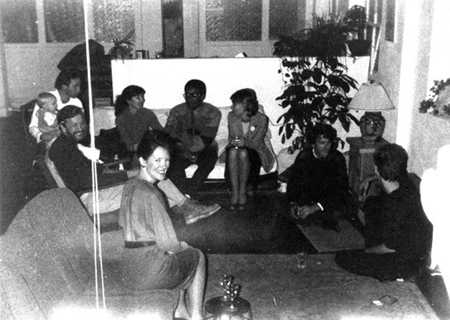
Phil Elie – impresario extraordinaire – flew in from his home in Paris last week to organize this event with some old friends in the Pillowtex warehouse. Now used as headquarters for the non-profit group, Give Us Names, the founders graciously allowed us access for the evening.
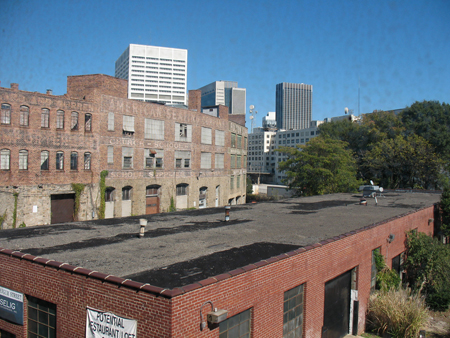
I discovered the space in 1980, while looking for a larger apartment. A loft space seemed ideal, as I was beginning to think about doing larger paintings at the time. When the realtor/owner told me about it, I was thrilled at the light and the square footage – 7,000 square feet on each of 3 completely empty floors right in what is now the Castleberry Arts District. A huge space with fabulous casement windows on two sides. But I couldn’t afford the rent by myself; $350 at the time. Since I had lived in communal houses in both urban and rural settings during my early twenties, that idea was out for me. I told my pal Arthur and we looked at it by flashlight one night, there was no electricity in the building at the time. The rest of the story is history.
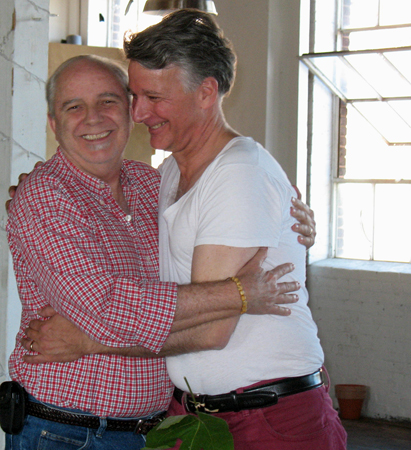
Phil and the artist Arthur Matthews (Theo), who was the first person to live in the space.
The historic real estate transaction included other background characters; I was working as a printmaker at Odyssey Studio in 1978 – from a contact via Jonny Hibbert (see below), and knew Arthur from his relationship with Kathleen, a co-worker in the frame division at the studio. They had split up and Arthur was looking for a place to live. Phil was hired at Odyssey in 1981 as a young printmaker, he was still in school at the Atlanta College of Art and was moving out of his place on St. Charles Avenue. The coincidental part of the tale is that I had lived right next door to Phil on St. Charles, from 1977 to 1979 – before I ever met him.
It was great to see Phil again. I had last seen him in San Francisco during my dotcom years from 1997-2001, and visited when he, Sally and the boys lived in Oakland.
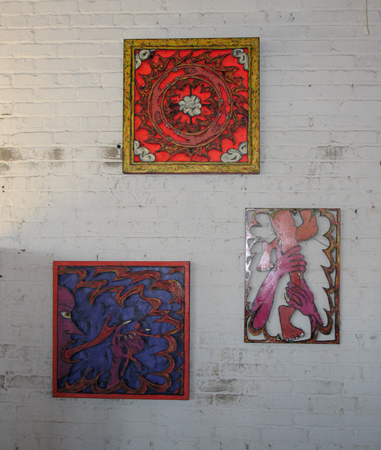
Three cut and painted wood pieces by Theo (Arthur Matthews).
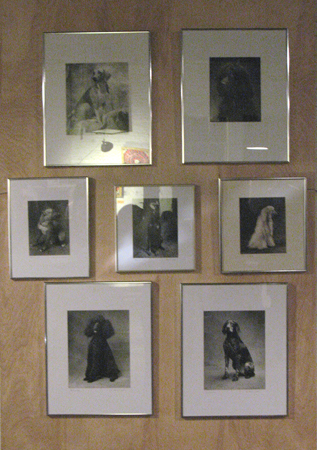
Malcolm Fordham, photographs of dogs circa 1995.
Malcolm briefly lived with Phil on St. Charles, along with other characters from my past – the arts writer Tom Patterson and artist Cornel Rubino. Tom had a crazy pal who used to bring moonshine down from the NC mountains and Cornel and his wife Linda ended up being neighbors at my next place over on Virginia Avenue, in the VA/Highlands neighborhood.
Malcolm and his wife Cindy came all the way from their generational farm in Dublin, Georgia for Saturday’s extravaganza. They left their 30 newly hatched chicks in a neighbor’s heated closet.
Some of Phil’s old pals from the Atlanta College of Art showed their work at the event.
Anne Cox, sculptures.
Tom Zarrilli setting up his assemblages and his wife Cindy’s drawings and paintings.
Tom recently had a show at Callanwolde with his photography of yard sales.
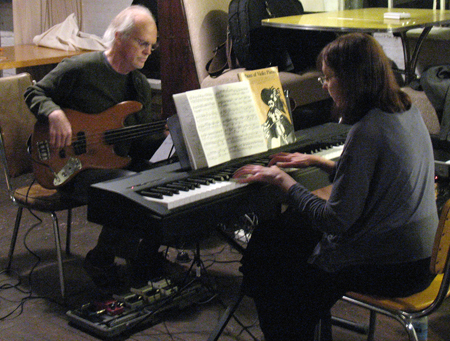
Bill and Roxanne Rea performed an amazingly beautiful interpretation of Christoph Gluck’s Orfeo ed Euridice.
I met Bill Rea when he played with the Glenn Phillips band, and have always adored his exquisite bass playing. We discovered that we both revere the bassist and composer Steve Swallow. Bill has worked with the Atlanta Symphony, composes, and he and Roxanne run a predominately classical sheet music store, Hutchins and Rae.
Brookhaven was another mecca for innovative young musicians in the 1970s; Glenn and Dan Baird lived out there, along with Philip Stone, David Michaelson, Jeff Calder and Neill Bogan…and so many others. Gina and I shared a house for a time in the neighborhood and it’s how we got to know so many of the characters. Bill and Roxanne still live there.
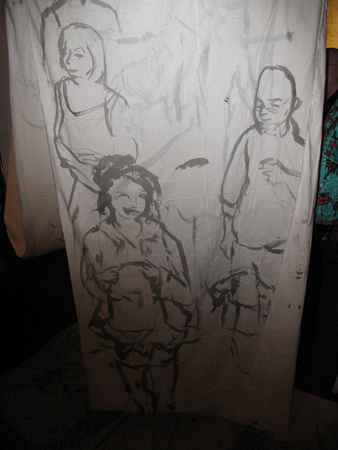
Some of the performances and installations were by Cindy Zarrilli, Terry Coffey, Deborah Heidel, Eloise, Stan Woodard, Elaine Ward, Charlotte Scott and Lisa Clark McKnight. I don’t have names for everyone, please add if you know anyone I left out.
My two paintings – Night on 22nd Avenue, oil on canvas 1999 and Nocturne, oil on canvas 2011.
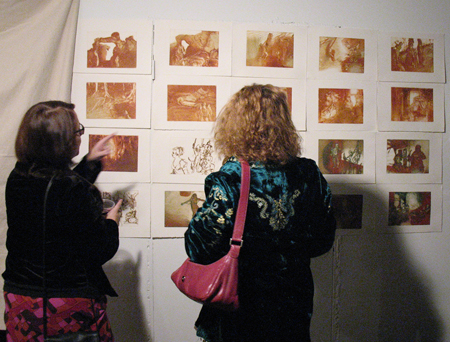
Phil’s sublime drypoint etchings.
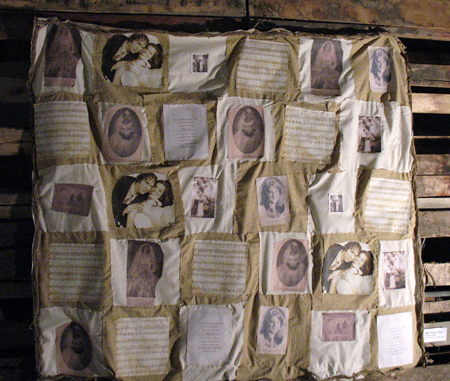
Quilt by Theda Bara.
Phil and David Dean, who also lived at Pillowtex.
Arthur and his wife Casey Green – a wonderful quiltmaker.
Jonny Hibbert, Kevin Haller, David Dean.
Jonny Hibbert, Jules Perry and Elaine Ward.
Jonny Hibbert was my first friend in Atlanta – we met at a Weather Report concert in mid 1977 when the great late Jaco Pastorius was in his full glory. Jonny introduced me to Atlanta’s world of young musicians, blossoming at the time. He happens to be the original producer for REM’s first singles on his own Hibtone label. My sister Gina, a freelance writer in Atlanta, was also pals with David Dean, his seatmate at that early concert. I think Jonny must know every artist and musician in Atlanta.
David and his lovely wife, Colleen.
Ann Cox, ACA grad.
Chris Edmonds, a local musician who had a band in the ’80s – with Kathleen Maher and Phil. Kathleen left Odyssey Studio in 1981, after having her son Rijn. His father – and the connection to Pillowtex – is Arthur Matthews.
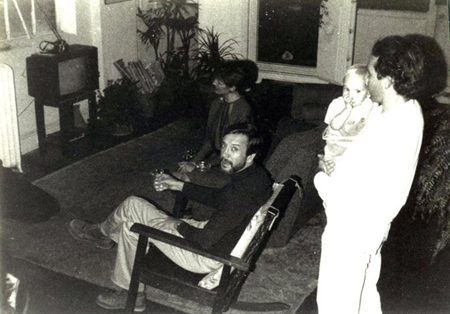
Some older photos from back in the day. Arthur holding Rijn with Philip Northman and Rosa.
Arthur and Rijn, Philip, Sally Elie and Rosa in foreground, Stan Woodard with unidentified woman, Phil and a man I can’t place:
Rosa and Phil formed the space ‘TV Dinners’ together, an early model for live entertainment and dinner. The space offered screenings of art films and had a former strippers’ runway for avant fashion shows.
Phil tells the story of Orpheus and  Eurydice. We missed seeing his wife Sally this time. Hopefully she’ll come with him on the next jaunt to Atlanta. Thanks, Phil – we’ll always have Pillowtex!
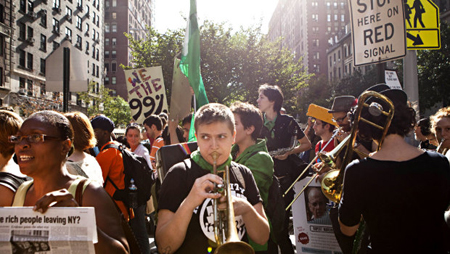
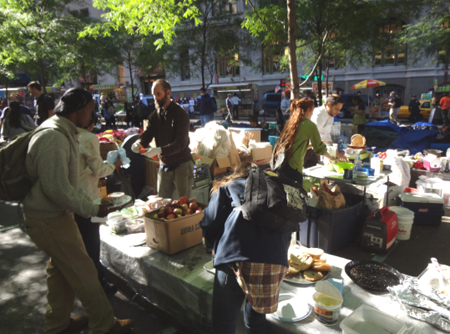
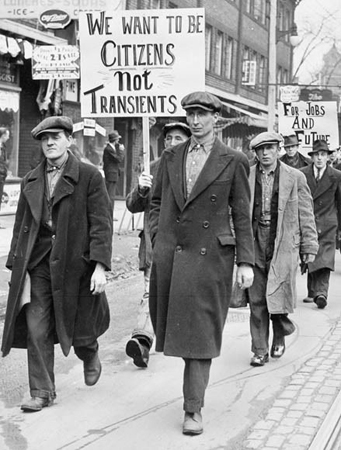
I’ve been following the Wall Street protests with interest. It’s all over Facebook – friends are engaged in provocative discussions, that show a proclivity to the left, with some right wing antagonism thrown in.
I’m proud of the occupiers; mostly youngsters who are uncertain about whether they’ll ever be able to pay off student loans or whether a job in their chosen field will be in their future. I’m proud of the fact that some of my older friends and acquaintances are going to NYC or to DC or any of the other participating cities, to show solidarity. If I were solidly flush, I’d be there too.
I’m one of the 99er’s, the unemployed millions who benefited from the  (mostly) Democrats’ extensions of insurance for a little over two years, or 99 weeks. That allowed me to look in vain for another broadcast job during those two years, to have time to sell my house in PA – that had depreciated in the failing market – and to begin a tiny art business on December 31st, 2008. Now almost three years later, that very small but growing business may actually sustain me well into the future.
Credit: AP Photo/Andrew Burton
Credit: CBS News/Brian Montopoll
But not many of those millions – often the older workers are booted out first – had my interactive skills, graphic design and web background or retail experience from the many and diverse television jobs that I held over the past 26 years. Not everyone had the benefit of management and software training offered on the job by both small and large companies. I got lucky. The corporations and companies I worked for offered good worker benefits, with top salaries and solid 401k plans. At least until their numbers began falling.
As an artist, early in my career I had to depend on my ‘product’; my prints and paintings, for sole income – so this is nothing new. But for millions who made a lifelong career in the corporate world or manufacturing or car sales or whatever business is now downsizing them – they have few alternatives. Their futures look bleak. Don’t get me started on healthcare reform.
More of the population will side with these protestors than with the top banks and CEO’s of financial firms. CBS News reported that ‘a new survey out from Time Magazine found that 54 percent of Americans have a favorable impression of the protests, while just 23 percent have a negative impression. An NBC/Wall Street Journal survey, meanwhile, found that 37 percent of respondents “tend to support” the movement, while only 18 percent “tend to oppose” it.’
This past Saturday Scott Simon of NPR interviewed Simon Fraser, a professor of history at Columbia University, about the Wall Street protests and what Fraser thought of them.
SIMON: Is this something deeply rooted in American politics?
FRASER: Yeah. What’s going on in Zuccotti Park is indeed deeply rooted in a long tradition of resistance and rebellion really against Wall Street and Wall Street in particular. It goes back all the way, in fact, to the nation’s founding. The first Wall Street panic happened in 1792 just after the birth of the nation. It was set off by an insider trading scheme engineered by a small circle of aristocratic bankers. And when their scheme collapsed and the local economy collapsed along with it, an enraged mob of New York citizens actually chased the leader of this scheme through the streets of New York, probably would have hung him had the sheriff not arrived just in the nick of time and carted him off to debtor’s prison, where he died several years later. And from that moment on, protests directed against the Street particularly has been a recurring feature of American history.
…we spent a long generation – the last 30 years or so – seeing very little resistance, despite the growing disparities and the distribution of incoming wealth and despite the obvious power of the Street in our political system over the last 20 or 30 years. There was very, very little opposition to that, a somewhat mysterious kind of quiescence. But now, shockingly and yet not so shockingly, given the extreme difficult conditions that people face today, that resistance has, so to speak, risen from the ashes and renewed its links to this long live tradition.
SIMON: And do you see it as being at the left or the right or what?
FRASER: You know, I see it as both. After all, the Tea Party, some of the Tea Party, partisans began by denouncing the bailout of Wall Street banks. And I know that in Zuccotti Park there are kinds of people, including Libertarians who resent the fact that the losses of the big banks are being socialized and paid for by American taxpayers while they make off like gangbusters with the profits. So, I think it’s mainly something that’s originating on the left but I think there are some sort of sympathetic echoes in certain circles of the Tea Party movement on the right.
SIMON: And to what degree have these movements recognizing everyone and every generation as different, to what degree have they succeeded, if not outright changing the government but changing policy?
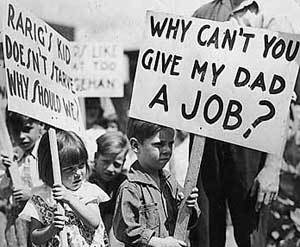
FRASER: Well, that’s a very variable story. Sometimes they have succeeded quite considerably and other times not at all. For example, the Populist movement of the late 19th century, which was a huge political movement that covered much of the Midwest and the South and elected governors and senators and other local officials all across the country, nonetheless had no success in actually weakening the power of Wall Street over the economic and political life of the country. On the other hand, the protests that emerged during the 1930s during the Great Depression had enormous success in reforming our laws so as to reign in the power of the Street. So, the record of success and failure is a spotty one. Sometimes yes, sometimes no.
The History Channel provides an interactive map of New York City’s protests, riots and gatherings for your edification, with events and dates noted.
Earlier this month, another NPR interview was conducted by Guy Raz with Beverly Gage, associate professor of history at Yale and gives us more American history of Wall Street protests:
RAZ: When did Wall Street become a place where protesters gathered?
GAGE: Wall Street really began to consolidate its power as the center of American finance in the years around the Civil War. And then, almost immediately after that, it became a target for protesters, really from a variety of places on the political spectrum. But throughout the late 19th century into the early 20th century, you had very regular demonstrations on Wall Street.
…the first movement that really coalesced around a kind of anti-Wall Street message was the populist movement, which came of age in the late 19th century. And then, by the early 20th century, you have a wave of different movements taking off. You have the rise of the Socialist Party in the United States, for whom Wall Street was the great symbol of American corruption and greed.
And you had the labor movement. And then you also had even more radical movements – to the left, anarchists, communists. But so you have a huge range of people from different positions in American society, with different messages but all really going after Wall Street itself.
RAZ: Much of the movement really culminates in a devastating terror attack in 1920, targeting J.P. Morgan. What happened?
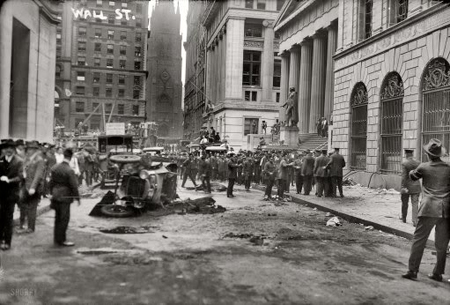
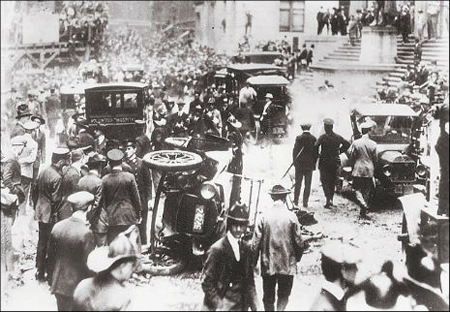
GAGE: Right. That occurred on September 16th, 1920, which was a pretty ordinary Thursday afternoon. And a horse-drawn cart exploded at the corner of Wall and Broad Streets. So, right directly next to the Morgan Bank, very close to the New York Stock Exchange. It ended up killing 38 people and wounding several hundred. And it was by far the most sort of dramatic symbol of this confrontation that had been building for a decade.
Credit – unknown. 1920 Wall Street explosion.
RAZ: The protesters today are mounting nonviolent protests. But what sorts of parallels do you see between those movements back then and what we are seeing today?
GAGE: Well, I think, right, on the question of violence, that was a very different world in the teens and ’20s. And so I don’t think that those kinds of comparisons have much to do with the protesters today…You’ve had lots of different sorts of people involved, and they haven’t always necessarily gotten together around one single piece of legislation.
But nonetheless, they’ve been visible. They’ve pressed questions about inequality, about the role of Wall Street and finance in the American economy, and just big moral questions about what do we want out of our society. And I think those are really the themes that you’re seeing coming out of the Wall Street protests today.
RAZ: Are there clear parallels, in your view, between the economic circumstances of those times and what we’re seeing today?
GAGE: Well, I think it’s really remarkable when you look at the span of the 20th century, we’re really seeing ourselves at the dawn of the 21st century in a lot of similar conditions to what would have seen 100 years ago. In terms of inequality, we have the same kinds of stratifications of wealth that we would have seen 100 years ago – and that actually shrank in the middle of the century, but have since widened back out.
In terms of labor organizing, we have very similar numbers. At their peak in the middle of the 20th century, labor unions recognized or organized about 35 percent of the private sector workforce. At the turn of the 20th century and now back at the turn of the 21st century, those numbers are back down around seven or eight percent.
So I think in terms of economic inequality, in terms of labor organizing, you actually see very, very similar dynamics now.
Credit – unknown.
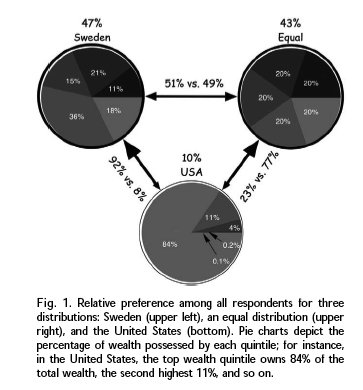
A Duke University 2005 research paper shows the wealth pie chart below that most of you have probably seen circulating on Facebook. The survey asked Americans to construct distributions of wealth that they deemed just, using unlabeled pie charts of wealth distributions – one depicting a perfectly equal distribution, one created from Sweden’s actual income distribution and the third from the US’s distribution.
Randomly drawn from more than 1 million Americans, the authors ensured that all had the same working definition of ‘wealth, also known as net worth, is defined as the total value of everything someone owns minus any debt that he or she owes’. The surprise was that 92% favored Sweden’s distribution over the US’s. Those figures crossed gender and political boundaries.
‘All groups – even the wealthiest respondents – desired a more equal distribution of wealth than what they estimated the current US level to be, and all groups also desired some inequality – even the poorest respondents.’
Finally, what some economists suggest is that a more even distribution of wealth is better for the entire global market, than having the top percentile wealthy. That is a sustainable model, the current one is doomed to implode and die.
Justin Fox, editorial director of the the Harvard Business Review cites economist Mark Thoma in his January 2011 post here:
There is an equivalent of a Laffer curve for inequality, but the variable of interest is economic growth rather than tax revenue. We know that a society with perfect equality does not grow at the fastest possible rate. When everyone gets an equal share of income, people lose the incentive to try and get ahead of others. We also know that a society where one person has almost everything while everyone else struggles to survive — the most unequal distribution of income imaginable — will not grow at the fastest possible rate either. Thus, the growth-maximizing level of inequality must lie somewhere between these two extremes.
Last week my pal Arthur and I had the pleasure of seeing the Eduardo Tami Trio and Dancers at GA State, sponsored by their Center for Collaborative and International Arts (Cencia) program. Dr. Fernando Reati, Chair of Modern and Classical Languages at GA State, gave a fascinating introduction on tango’s origins as a dance form in the 19th century.
“All sources stress the influence of the African communities and their rhythms, Â while the instruments and techniques brought in by European immigrants played a major role in its final definition, relating it to the Salon music styles to which Tango would contribute back at a later stage, when it became fashionable in early 20th century Paris.”
Tami’s trio has performed all over the world since forming in 2002.
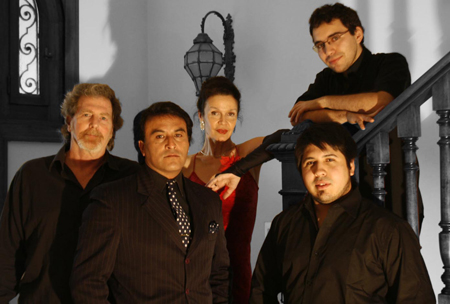
Virtuoso flautist Eduardo Tami is from Buenos Aires and has a diverse musical background. He offered some background on the traditional dance form and put on a lively show. His current trio includes guitarist Sebastian Enriquez and pianist Leandro Marquesano.
Dancers Claudia Marziano and Toni Saganias, touring with the trio, were spectacular – we met them and the musicians at a lovely reception after the performance. Ms. Marziano teaches and dances in Buenos Aires and was as warm and engaging as she could be with strangers. My high school Latin doesn’t translate well to Spanish and Mr. Saganias does not speak English or French – so I was unable to communicate with him other than to say muy bueno.
This was shot at another performance this year. It’s one of the more energetic numbers that the dancers ham up to the hilt.
A few of the works they chose for their Atlanta debut were originally composed by the great Astor Piazzolla.
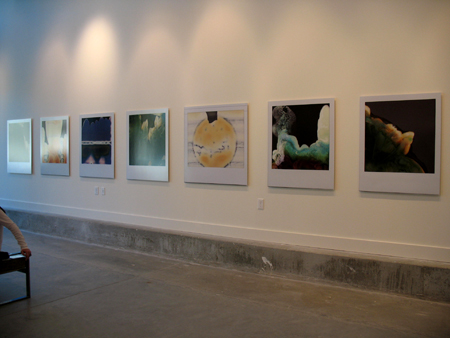
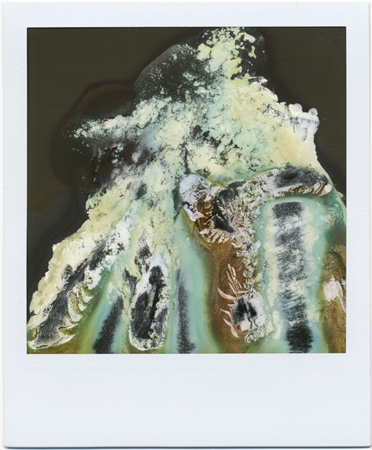
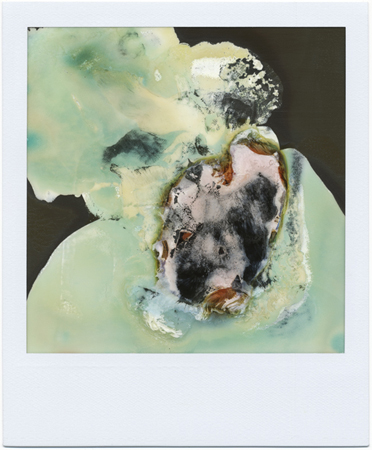
Continuing my goal to hit most of the new gallery spaces in town within my first year of being back in Atlanta, I visited Poem88 off Howell Mill road yesterday for an artist’s talk by Ryan Nabulsi. Nabulsi is a young photographer working with old technology, as the gallery blurb notes:
“…Ryan Nabulsi’s camera-less photographs represent a natural conclusion to the goals of Steiglitz and Steichen in promoting pictorial photography. Relying on the manipulation of the photographic chemical process for instant photography, Nabulsi generates abstractions of lush color perhaps more akin to color field painting.”
The artist is using film made for the old Kodak instant camera SX-70 but is not shooting with it. Instead, he’s manipulating the chemicals within the ‘pack film’ to create these images. In his artist statement he says:
“The work uses a familiar form of vernacular photography from the past, the SX-70 Polaroid, an instant analog film, and abstracts the chemistry using a variety of camera-less techniques. In addition, enlarging the images to ten times the instant film’s normal size, the familiar encounter with the SX-70 is taken out of context and brought into a different view.  These transformations explore the materiality of photography, the literal ‘insides of the medium.’  The contained pod of chemistry in the instant analog film is detached from its implied representational potential and given a new life that embodies the intersection of art and science.”  Â
Two large photos below courtesy of the artist.
A photographer friend of mine conducted similar experiments with this early polaroid technology back in the mid 1980’s, except that he would shoot and then manipulate the ‘print’ during the brief development period of maybe 3 minutes. I still have some of those fabulous abstractions….
Pyramid Scheme, ca. 1973, mixed media on paper. James Herbert. American, born 1938.
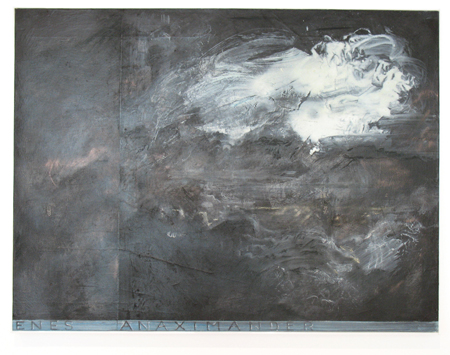
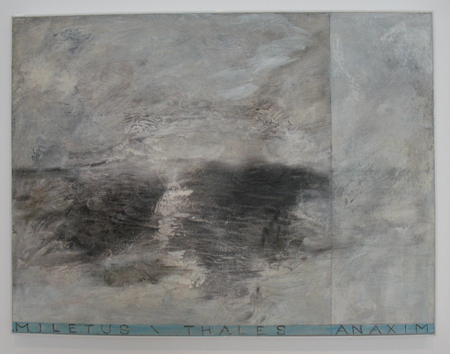
Miletus: Thales, Anaximenes, Anaximander, 1990, mixed media on canvas. Genevieve Arnold. American, 1928-2005.
Arnold refers to the ancient Greek city of Miletus in these paintings, the birthplace of modern philosophy and the three scholars cited in her works above. Installed together, the paintings create three equal squares, representing the three scholars of Miletus.
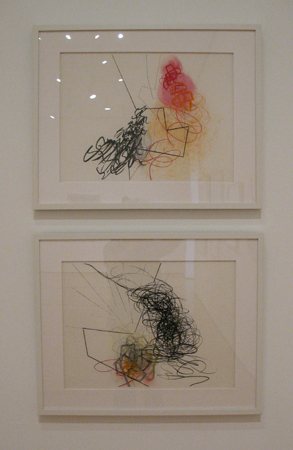
February 9, ’09 no. 1, 2009 and February 11, ’09 no. 1, 2009. Pastel, oil pastel and pencil on paper. Rocio Rodriguez. American, born Cuba 1952.
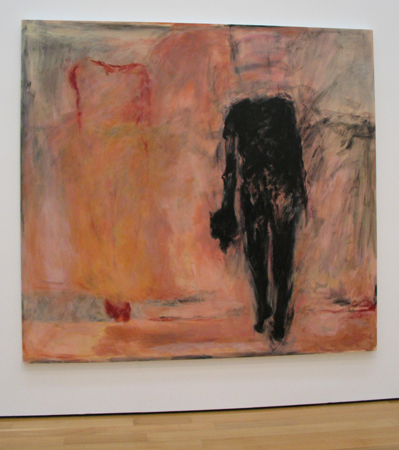
Schism, 1990, Oil on canvas. Rocio Rodriguez. American, born Cuba 1952.
This painting by Rodriguez was quite large and reminded me of the great Bay Area figurative painter Nathan Oliveira’s work, who died last year.
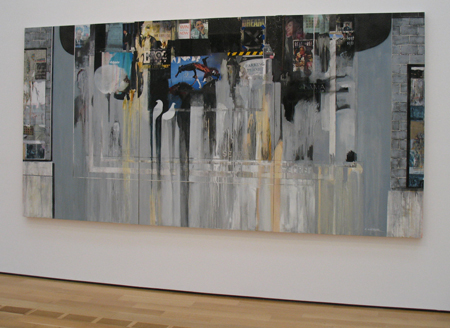
Wall Spirits and Other Secrets: Believe 01.20.09, 2008. Mixed media. Larry Walker. American, born 1935.
Basic Masai – II, 1989-1990. Acrylic on canvas. W. Medford Johnston. American, born 1941.
Due Soli, 1960. Acrylic on panel. George Beattie. American, 1919-1997.
The painting above simply glowed. The oranges, pale cobalts and pinks looked almost like encaustic and the artist achieved a unique luminosity from acrylic paints – which at the time were not that ubiquitous.
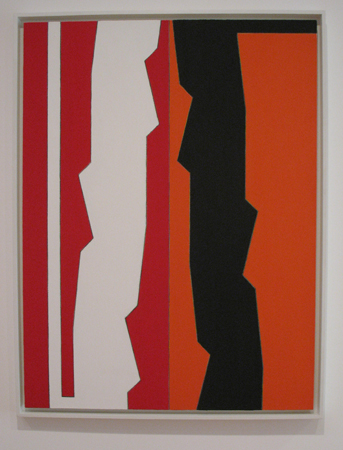
Get With Red, 1962. Lacquer on Masonite. Howard Thomas. American, 1899-1971.
A very jazzy painting. (I mentioned that before knowing that Thomas used music as inspiration during painting – as I do)
I also visited the Huber Family collection now on display at the High; Embracing Elegance, but was chastised by security for taking photos. So none to show from that exhibit, up until November 27th.
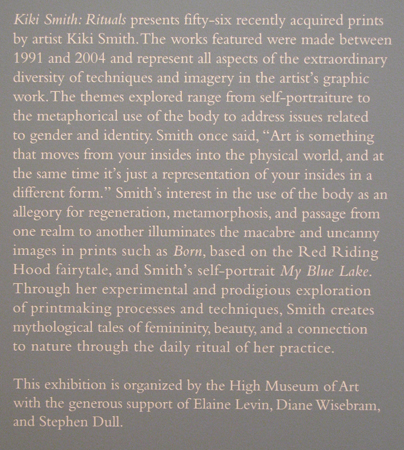
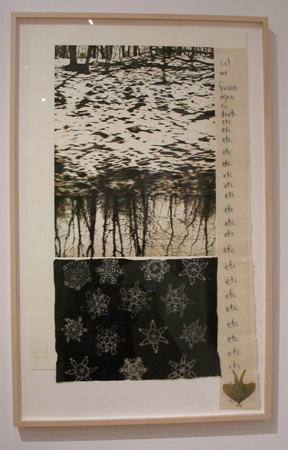
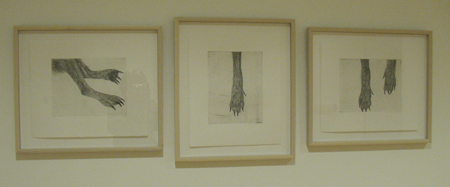
The third show I saw at the museum was a recently acquired collection of 56 prints by the American artist Kiki Smith, including works made between 1991 and 2004. Feminist based, her work can be both charming and humorously disturbing. I especially enjoyed her reinterpretations of traditional fairytales. The writer Angela Carter used ‘latent content’ of the tales in her 1979 The Bloody Chamber, and like her Smith turns the tales into commentary on gender and social inequalities.
Although some may critique her drawing capabilities, she herself notes in this video that she made the ‘problem’ work for her. “Either you’re stopped by what hampers you or you’re not….you can have tremendous talent but it doesn’t mean that you care about it. Being an artist is sort of a weird combination of different things…of needing to do something.” Â
This New York Times review by Holland Cotter of her 2006 show at the Whitney sheds a more serious light on her objectives. More about her background can be found in another interview during the same year with Michael Kimmelman. The exhibit at the High Museum is up until January 22nd, 2012.
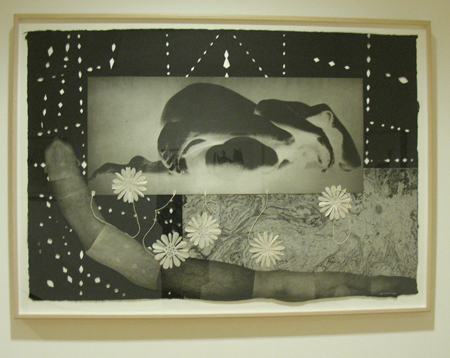
Worm, 1992. Photogravure, etching, aquatint, and collage.
Etc., Etc., 1999. Photogravure, collaged lithograph, and photolithograph.
Born, 2002. Color lithograph, 68 1/8 x 56 1/8 inches.
Jewel, 2004. Aquatint and etching: set of three prints.
Rapture, In a Field, Splendid, 2002. Aquatint, etching and drypoint; series of three prints.
Close-up of ‘Splendid’.
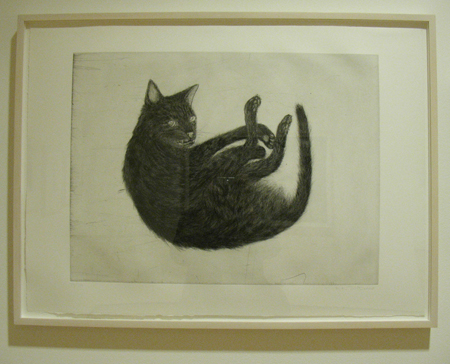
I did not get a title for this etching of a cat, who may be dead…
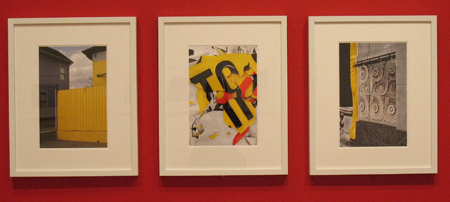
Finally, I’d been wanting to see Chip Simone’s exhibit “Resonant Image” at the High for months. It’s only up now until November 6th. Chip has been a local photographer for decades and studied with Harry Callahan. I’ve always appreciated his work. Some of these more recent photographs look like abstract paintings. He switched from film to digital technology in 2000.
Unfortunately, I didn’t get captions with any of these in my efforts to shoot quickly without being noticed…
My father, Robert Arlington Webb (1911 – 1971), was a film editor who grew up in Hollywood during its early heyday. The Webbs lived in several different areas of LA during the first ten years after they moved there in 1924 from Springfield, IL. At one time they lived across from Paramount Studio, at another period they were neighbors with the Coopers (Gary) and in 1933 Charlie Chaplin’s studio was nearby. Dad’s father bought land in what is now Brentwood, back when the area was mostly orange groves.
At least 2 of the 5 houses that he built for his family in 1937 were still standing when I visited in 1998, their sidewalks lined with orange trees scenting the Los Angeles evening. You can view one of the original houses that my uncle Jerry and aunt Helen lived in until 1994 when they moved to the San Francisco Bay area.
Dad, Mom and me circa 1952 with Jerry Webb on the far right. Aunt Helen holding the towhead, with cousin Judith looking on.
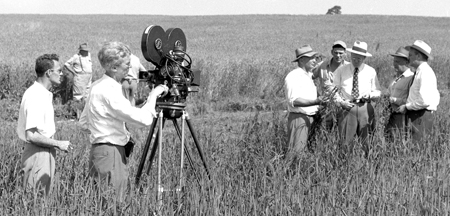
The three Webb sons and their relatives were involved in the film industry. Dad’s older brother Jerry worked as a film editor for 20th Century Fox with the producer Darryl Zanuck and he also worked for the director John Ford on a film in 1934, with my father as either an assistant director or as an editor. If anyone could identify the cameraman in this shot, we might know what film it is. I suspect it could be Lost Patrol, a WWI film shot in the desert. Dad stands to his left. Ford is in the center right with the hat and tie on.
Our cousin Robert C. Jones is an Academy Award winning editor and screenwriter who now teaches film at USC. His dad was Harmon Jones, who directed feature films, and much of the 1960’s  TV series, Rawhide. Our family enjoyed watching a young Clint Eastwood rise to fame after his role as Rowdy Yates.
Robert C. Jones, USC photo.
But what my father will be remembered for is what he tried to forget: the US Government sponsored films about the Nazis that were compiled after the war. My dad never talked about working on the footage that depicted Nazi atrocities, or of his time in Germany. He had canisters of the film, possibly dubs of the master reel, sequestered away on the top shelf of his closet during our childhood. Our mother tried to get him to do something with it that would bring a financial legacy to his children, but I suspect he felt that would be ethically wrong. He may have donated the film to Princeton’s Firestone Library or to the Library of Congress, which is what I remember her telling me.
Dad had enlisted in the Navy and was sent to Germany to work on editing footage for the Office of Strategic Services’ (OSS) film unit, headed up by the director John Ford.  He spent a year or two in Germany around 1943 to 1945 as the supervising editor on the evidentiary documentary The Nazi Plan, directed by Ray Kellogg and shown at the Nuremberg Trials. He was one of 3 American editors chosen by Ford to work on this four-and-a-half-hour film, which consisted of 22 reels culled from thousands more feet of documentary film made by the Germans themselves. The other two editors included Robert Parrish and John McCafferty. (Another link that offers more video can be found at the US Holocaust Memorial Museum site here.)
The official US government film of the trial became “Nuremberg: Its Lesson For Today” and was shown to the German people but never released in the US. Speculation as to why it wasn’t released include political sensitivity to the American efforts to rebuild Germany after the war, and to the Soviet Union’s 1948 blockade of Berlin. “The new threat was Soviet expansionism”.
A restoration of  ‘Nuremberg: Its Lesson For Today’ was completed  in 2009 by Sandra Schulberg, niece of Budd Schulberg, who worked on the The Nazi Plan as a search commander. Sandra’s team restored the film by making a new negative.  In the process, they did not change a single frame of the original, but did reconstruct the soundtrack using original sound recordings from the trial. It has shown all over the world since then. A good review with information on the political issues can be found here.
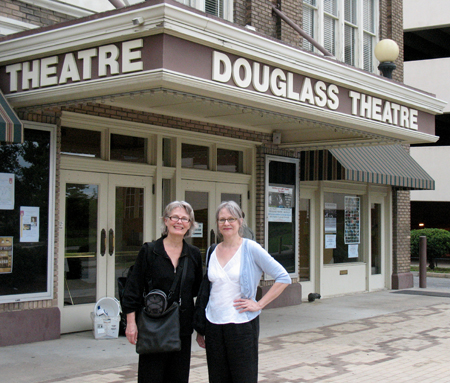
Ms. Schulberg’s restoration showed Tuesday night at the historic Douglass Theatre in Macon, GA and my sister Gina, her partner Mike and I drove down from Atlanta to see it.
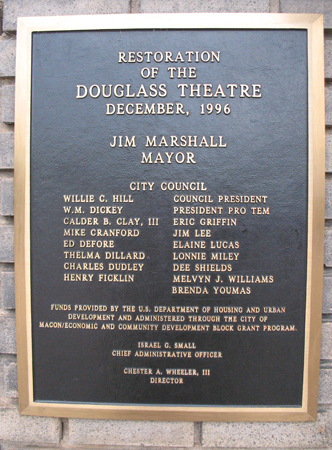
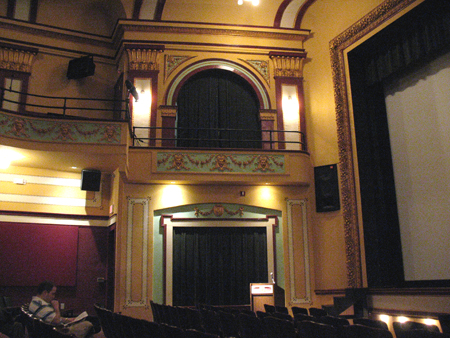
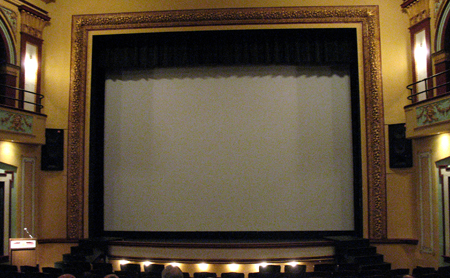
Franklin ‘Camp’ Bacon and Robert Fieldsteel are hard working volunteers who keep the theater running, and Camp treated us all to dinner in Macon. He also gave a lively introduction and some background for the film. Fieldsteel has his own fascinating LA history; he worked with the director John Cassevetes and is playwright and artist in residence at Wesleyan College for Women in Macon. The Douglass Theater was restored in 1996 and the jewel-like interior reminded us of a small Italian opera house.
The substantial audience gave the film great reviews via Camp’s ingenious rating system – 5 clothespins dropped into a paper bag was the high average.
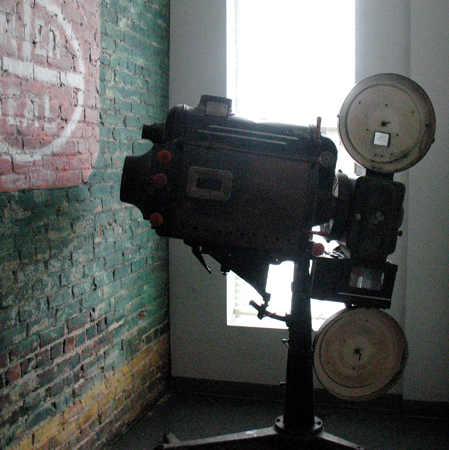
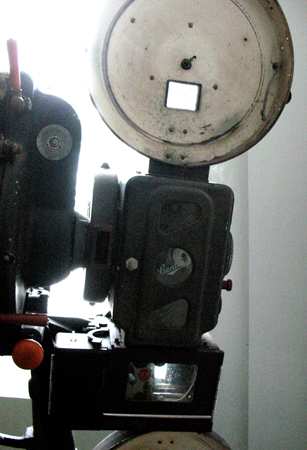
One room held a classic 1940’s Century Projector.
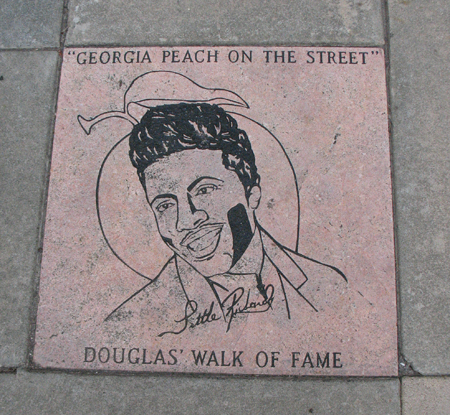
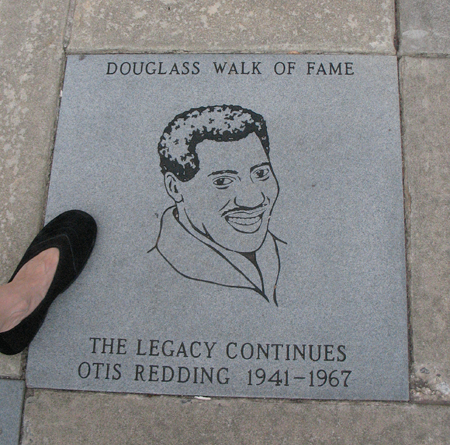
The Walk of Fame musician homages in front of the theater.
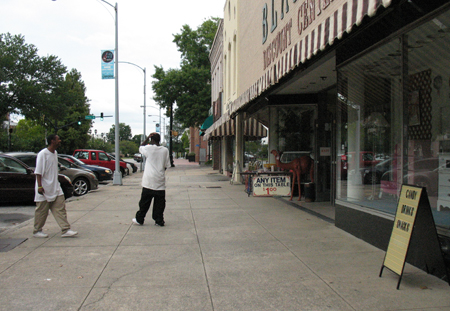
I hadn’t been to Macon in over 25 years and the town is architecturally interesting, although its revitalization hasn’t yet brought throngs of people to the downtown area.
The Dempsey Hotel, now apartments for the elderly and disabled citizens. Once a grand hotel.
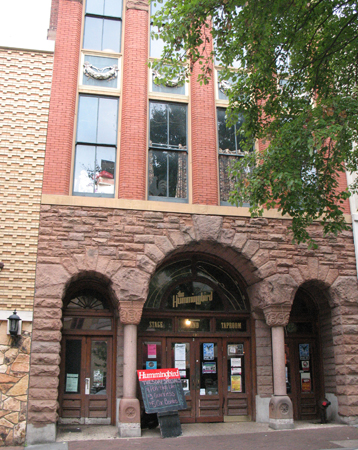
The Hummingbird Stage and Taproom, live music.
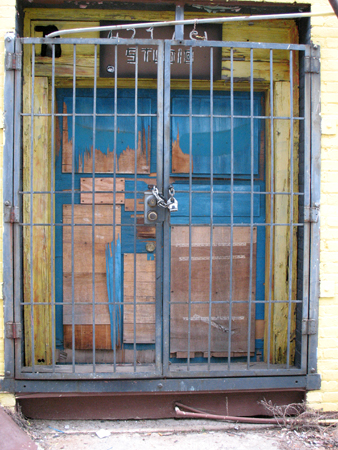
Many businesses seemed to be closed and boarded up.
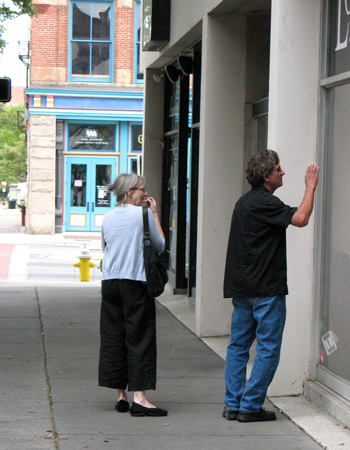
Local fashionistas in front of one of the many thrift stores.
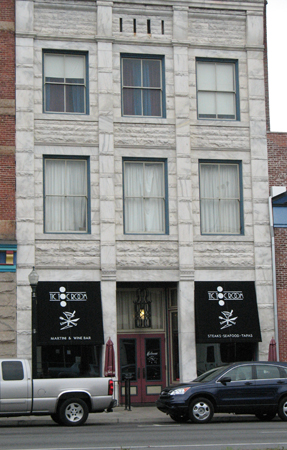
The Tic Toc Room, a once legendary nightclub, where Little Richard got his start. Now a restaurant.
Ms. Schulberg’s film is a lovely, albeit difficult, belated tribute to our dad, too bad he wasn’t around to bask in it. Much credit also goes to my sister Gina for contacting Sandra and organizing a bio page for him on the film’s website. Without Gina’s efforts, brother Rob and myself might never have known about the film.
Dad’s last government sponsored gig was a year spent in Burma from 1953-’54, when he was sent over to train young editors in their emerging film industry. He spent the rest of his career in Princeton, NJ and NYC as a highly successful film editor in commercial television.