To conjecture and not to test is the mark of a savage

That’s from George Polya, who was Professor Emeritus at Stanford and a mathematician who wrote the 1968 book I’m reading on math; ‘Mathematics and Plausible Reasoning, Volume II – Patterns of Plausible Inference’. The father of problem solving. I like the way he thinks. 

Interesting stuff, opposite to Aristotle’s suggestion two thousand years ago that all reasoning conforms to certain patterns. Polya argues that there are practical limits to impersonal, universal and self sufficient reasoning.
 
The basis for difference: your own background, judgement and intuition affects any outcome. ‘It cannot escape being provisional…. The direction is impersonal, the strength may be personal.’
Inferred = forgeddabout the genes already (which jibes with the new science of genetically identical bacteria wildly diverging and mutating). The relevancy of life and how one is formed by it, determines reasoning and style. 

Polya: “…Demonstrative reasoning appears as ‘machinelike’, definite, final, while plausible reasoning appears as vague, provisional, specifically ‘human’. ….the ‘strength’ or the ‘weight’ of the conclusion may depend not only on clarified grounds such as those expressed in the premises, but also on unclarified, unexpressed grounds somewhere in the background of the person who draws the conclusion. A person has a background, a machine has not. Indeed, you can build a machine to draw demonstrative conclusions for you, but I think you can never build a machine that will draw plausible inferences.”

So maybe I’ll crack the math codes after all.
“My method to overcome a difficulty is to go around it.” G Polya           

UCTV is my current favorite TV channel. I always find interesting programming there, and last night on Conversations with History, Stanford Professor Lucy Shapiro, spoke about having come from an artist’s and musician’s sensibilities into the world of microbiology. It’s fascinating to listen to her trajectory. She found herself confident enough to try anything after having studied the fine arts. ‘Thinking differently is critical’.


Posted in Daily meanderings | Tagged , , , , , , , , , , | 1 Comment

Portraits

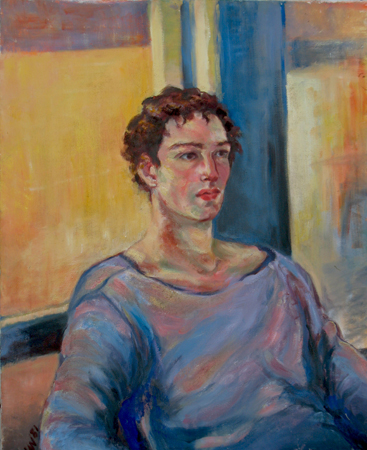
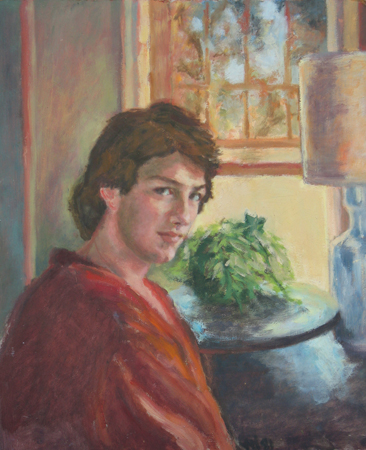
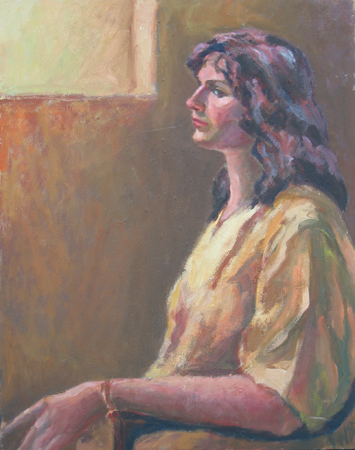
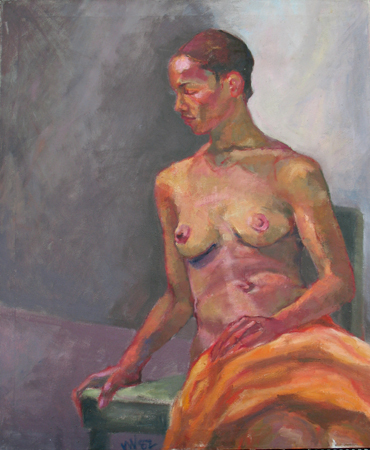
Portraits. Suddenly they’re the rage. Every art critic/blogger seems to be showcasing someone’s new portrait of a hip-hop celebrity, or a museum’s retrospective of a newly discovered, been around a long time, figurative painter. The National Gallery held a portrait competition last summer and these are the finalists. Not many loosely painted or expressionist works. Of course I live near the figurative capital of the world; Philadelphia.

Peter Schjeldahl was one of the jurors and while I don’t agree with all the choices, in this interview he has a thoughtful take on how to look at art: ‘I think the most sensitive, intelligent, cultivated, exciting people I know in their interest to art do not register on the public level. I mean, they’re not part of institutional structures. They wouldn’t be caught dead in it.’

and this gem: ‘the only education that matters in aesthetics is self-education.’


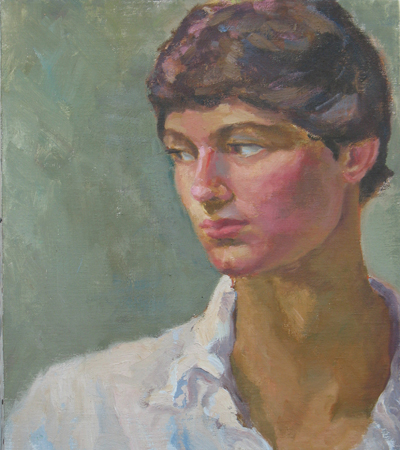
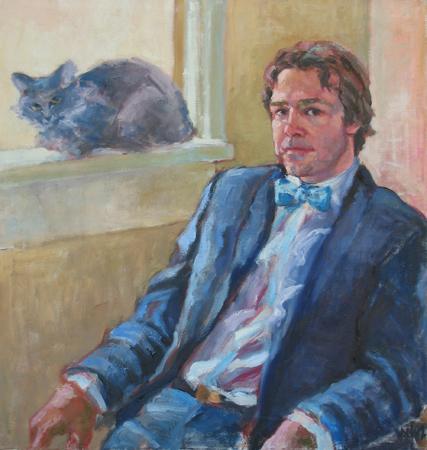
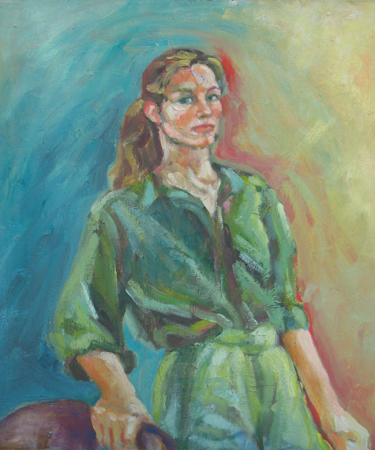
The following portraits are all from 1981-82 and are of friends, models – anyone who would sit long enough for me to paint them. Fond memories, gentler times.

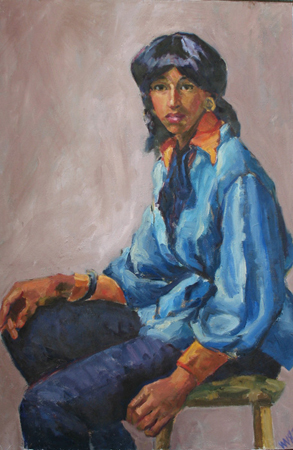
Rosa in blue shirt. Oil on canvas, 35″x25″ 1982


Teddy. Oil on canvas, 17″x15″ 1981


Malcolm and Louise. Oil on canvas 30″x32″, 1982


Neill. Oil on canvas, 34″x27″ 1981


Bill. Oil on masonite, 28″x24″ 1982


Girl with yellow background. Oil on canvas 30″x25″ 1982


Rosa, nude. Oil on canvas, 37″x30″ 1982


Self portrait. Oil on masonite, 25″x24″ 1982

Posted in Daily meanderings, Paintings | Tagged , , , , , , , , , , , | 2 Comments

Exhibit – Wayne Art Center

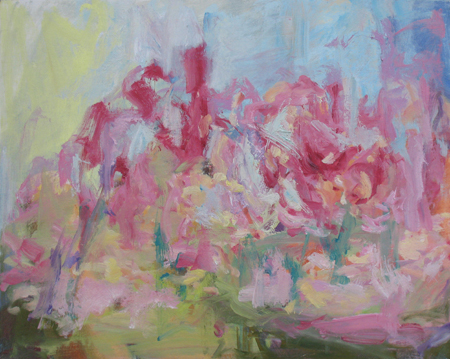
A 2009 spring painting, Ariettes Oublieés, will be shown at the Wayne Art Center’s members exhibit, juried by Michael Gallagher, a professor and painter at the Pennsylvania Academy of the Fine Arts. The exhibit runs from October 25th to November 21st, 2009.

I’m happy to show this piece, it’s one of my recent favorites. While I titled it after a Claude Debussy song set to a Paul Verlaine poem, it really began with a dream. The dream had something to do with fractured light, or falling water in light or something of that sort. I was so struck by it that the next day I tried to paint what I had seen in the dream. I also see the work as a turning point stylistically; looser and somewhat less rigid than previous work, with a more modulated palette.

It also had something to with the beautiful tulip magnolia in my front yard that drops its petals in early spring.


Quita Brodhead founded Wayne Art Center in 1930. Born into privilege in 1901, she studied painting at the Pennsylvania Academy of Fine Arts with Arthur Carles. Exhibiting widely during her life, I saw her work at the Woodmere Museum of Art when I exhibited there this past spring. She lived to be 101 and never stopped painting. 

One of her teachers at the academy told her to ‘go home and wash dishes’. She says ‘I don’t know what made me stick it out….I just didn’t want to admit defeat.’

I love her laughing at her own abstractions. Enjoy this clip of her talking about her work and early days at the academy.


Quita BrodheadAwesome video clips here

Posted in Daily meanderings, New Work | Tagged , , , , , , , , , , , , , , , | 2 Comments

David Hockney pontificates and paints

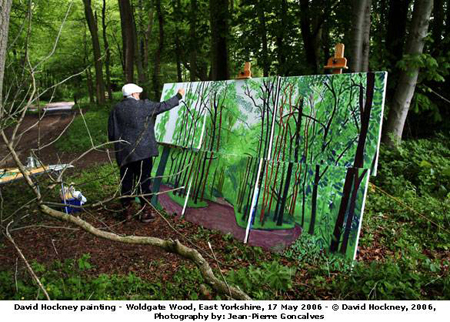
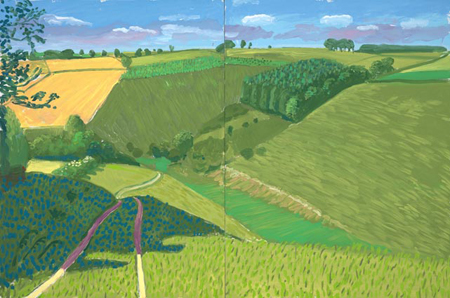
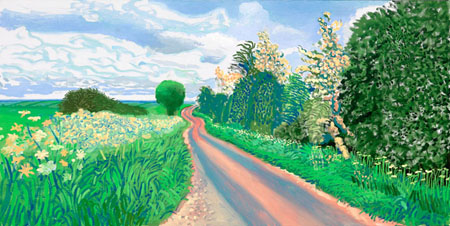
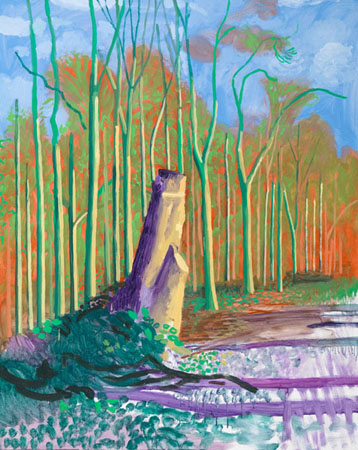
I liked David Hockney’s early portraits but his latest landscapes are quite a surprise if you haven’t yet discovered them. They remind me of a modern Matisse who might have used a lot of dioxazine purple to offset his phthalo greens and cadmium oranges. The liveliness of Hockney’s eye and hand are much evident and his intense colors are vibrantly flat like the rest of his work. And it’s fun to watch his crusty antics, smoking non-stop in the film clips by Bruno Wollheim.

The New York Times ran a piece today with an excerpt from Wollheim’s film, on his plein air work; something he hadn’t really done much until his later years. I especially liked what he said about photography and painting, that the camera can’t: ‘get the beauty of this, it just can’t get the thrilling space I’m in. We’ve got to the point where we think the camera can photograph anything at all. But it can’t really, it can’t compete with painting at all….The paintings are much more vivid than the photographs are’.

Now 70, Hockney is out in the rolling green hills of the English landscape, carrying on a long tradition and making Turner proud.

His current exhibition is at PaceWildenstein in NYC from Oct. 24-Dec. 24th, 2009.

Bruno Wollheim’s film clips here.


An exhibit of Hockney’s East Yorkshire Landscape at L.A. Louver gallery, 2007:


Lawrence Weschler wrote an article in the New York Review of Books on Hockney’s iPhone paintings that you can view here.

And for the Tate Museum’s 2007-2008 exhibit, ‘Hockney on Turner Watercolours’, Hockney chose 150 of Turner’s watercolors. He talks here  about how exciting it was to choose the works and shows some of his own large paintings that were on display at both the Tate and the Royal Academy.

Posted in Art reviews, criticism and blogs, Daily meanderings | Tagged , , , , , , , , | 3 Comments

October paintings

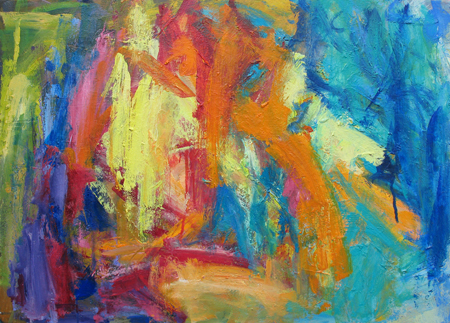
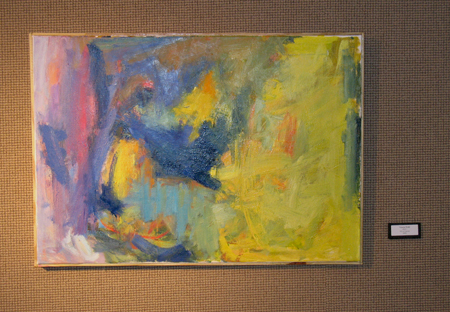
On the third draft of this painting, I now consider it finished. An earlier version is shown in my September 18th posting.

Flight, oil on canvas 19.5″x27.5″, 2009.


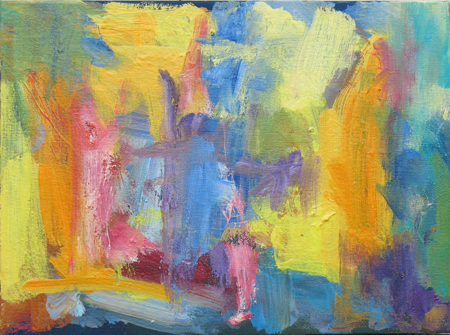
This is a small piece I worked on at around the same time.

Path, oil on canvas panel 9″x12″ 2009.


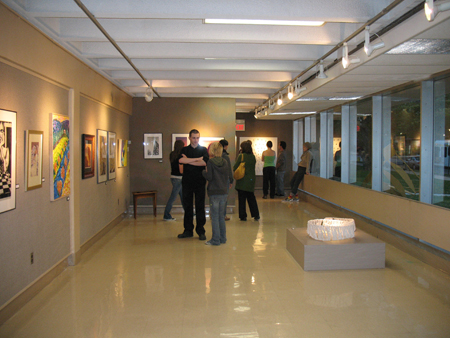
And a couple of shots from the opening, ‘A Woman’s Perspective’ last week at WCU’s Long Gallery. ‘Medi 1’ is hanging until November 7th. Darci Goldberg from Chester County Art Association curated the show in conjunction with the PA State System of Higher Education Women’s Consortium. 

Posted in Daily meanderings, New Work, Paintings | Tagged , , , , , , , , , , , , , | 2 Comments

Television and Literacy

I wrote this article in response to a friend’s claim that television was always a narcotic for him, that it cured his hives, lulled him into semi-consciousness and proved more effective than any chemical. Because it touches on reading and the power of literacy, it seems worth posting again here on my own blog.
It was published on the Reality Sandwich blog in 2007.

TV and Power?

Psychiatrists and doctors will point out that hives can result from either allergies to food or stress. Television is indeed similar to a drug and one that can lull a consciousness from being alert and imaginative (and nervous) into the nepenthe of a dullard. The hives that Mr. Hossaini suffered vanished with his distractions – the television programs he watched equalling the effect of the sedative his doctor prescribed.

However, there are some distinctions to be made about a visual medium evolving “alongside consciousness”, based on the brain’s difficulty in distinguishing between orality and literacy. In this week’s New Yorker, Caleb Crain in ‘Twilight of the Books’ writes about the history of literacy and how television may in fact be damaging our abilities to retain and process information. Proust elaborated on Ruskin’s comparison of reading to a conversation with the “wise and noble” by noting that it went further than that. Reading, Proust said, was “to receive a communication with another way of thinking…while continuing to enjoy the intellectual power that one has in solitude and that conversation dissipates immediately.”

Research suggests that abstract thinking is the result of being literate, while the oral mind-set “embed their thoughts in stories…Cliche´and stereotype are valued, as accumulations of wisdom and analysis is frowned upon, for putting those accumulations at risk”. This reminds me of my years spent in the highly illiterate broadcast world, where TV is not only the object of work, but also the main topic of conversation; recountings of the previous evening’s serial dramas or comedies almost the only culture around the water cooler. If you didn’t watch television religiously, you couldn’t become a member of the sect and you would have no idea about the storylines. If one ever tried to involve these ‘orals’ in discussions that might be investigative or analytical or even more dangerous, anything resembling high art or culture, the immediacy of being an outsider (and an outcast) would be obvious to all. “As the scholars Jack Goody and Ian Watt observed, it is only in a literate culture that the past’s inconsistencies have to be accounted for, a process that encourages skepticism and forces history to diverge from myth.”

Crain says that the antagonism between words and moving images begins early; “babies know on average 6-8 fewer words for every hour of baby DVDs and videos they watch daily…. and that conflict continues throughout a child’s development.” Perhaps this is why painting has persisted as an art form alongside literature. Our brains can’t process both in a medium at once without making us stupid. Television and film can be wonderful, but apparently the combination of content and imagery isn’t as interesting for our brains as words and visuals in their respective separate and distinct mediums.

Imagination, Einstein said, is more important than knowledge. What studies have found is that visuals combined with words, is more than we can handle, at least in this phase of our evolution. Hossaini has an intriguing question to make, but at this point I wouldn’t stake any claim on consciousness evolving alongside television. Instead, it might be suggested that the opiate of the medium has dulled our consciousnesses to the point of no return. Reading skills have worsened dramatically in the past few decades and we all know what’s happening to book sales and newspapers. The Internet however, Crain notes, doesn’t seem to ‘be antagonistic to literacy’. But if streaming media overtakes it with networks like YouTube and Myth TV, these synergies could vanish.

The opportunity to watch opera, poetry, paintings and dance on television is akin to seeing animals in a zoo. It will never replace the excitement or thrill of interacting with a musician or poet directly in a ‘live’ performance or even replace standing before a painting in a museum. Obviously this is one reason some actors still prefer the energy of the stage to film. When I lived in rural and remote Nova Scotia more than 30 years ago, I was stunned by the (mostly oral and illiterate) community’s involvement with music. Celebrations and livestock fairs were punctuated by amateur and excellent fiddlers, singing, bagpipe playing and dancing. Everyone got together and made music. They didn’t watch much TV – this was still an agrarian culture with summers spent bailing hay and slaughtering sheep. I was struck by the way they kept a heritage vital through one form of art that everyone, young and old, was involved in. I question that the community (or music) would have existed if everyone had sat around and done little but be glued to a monitor.

I found Daniel Pinchbeck’s notes on Mr. Hossaini’s piece interesting. The idea of transformation, especially in terms of ‘conditioning into a consumerist belief system’ is obviously what advertising has been doing since television’s founding. Whether it’s our only hope will be determined by the power elite and who owns the airwaves (legally we the viewers do). But as Ralph Nader claims, corporate control of money is now governing the world, and not governments.

Mr. Nader’s recommendation for holiday reading in 2007 was: The Bank Teller and Other Essays on the Politics of Meaning, by Peter Gabel (Acada Books.) Law Professor, Law Dean and college President, Peter Gabel gets down to fundamentals about the “politics of meaning.” This is not a muckraking exposé but rather a relentless push on readers to examine their isolation and alienation from one another, their neighborhood, workplace, and community without which a functioning democracy cannot evolve.

Finally, I would ask what concepts or innovation television has spawned except perhaps, the technology of its own being. Why the need for transcendental television when it so readily accomplishes that task?

Posted in Daily meanderings, History | Tagged , , , , , , , | Leave a comment

National Parks and inspiration

I assume not everyone has been glued to their TV watching the Ken Burns epic all this week on PBS on National Parks: America’s Best Idea. Whether you like his filmmaking or not, the narrative and history of our parks and how they were preserved was enlightening and stunning to watch. Peter Coyote told us the other night that Jimmy Carter had bypassed Congress during the fight to expand protected land in Alaska and invoked the Antiquities Act in 1978 to create 17 national monuments covering 56 million acres. It’s startling to remember that Carter was fighting powerful commercial interests; the discovery of vast oil deposits and the gas pipeline had brought jobs and the promise of a strong economy to Alaska.

But Carter and Morris Udall, his Secretary of the Interior, knew that counting on oil lasting forever would be irresponsible. The parks and wildlife were their focus and everyone should be thanking Carter for his prescience. 

‘…it was still the largest single expansion of protected conservation lands in world history. The national park system, with 47 million acres added to its care, had suddenly more than doubled in size.’

What I liked best about the series was his inclusion of historians, writers, activists and Park Rangers themselves. These intimate stories really tell the mystery of nature’s allure and why as a culture we need to preserve it. Almost every tale about preservation had as its backbone a wealthy or thoughtful philanthropist who fought to protect wildnerness. At the same time, iconoclasts like John Muir and Adolph Murie stubbornly continued, despite conflict and opposition, to evolve standards of conservation that brought back wildlife and eliminated developers’ plans.

Like one of the historians who talked about an early parks adventure in the back of the family station wagon, my dad took us on an almost month long cross country trip back in 1961 to visit various National Parks along the way; The Grand Canyon, the Petrified Forest, the Painted Desert, Santa Fe National Forest and the Gila Cliff Dwellings National Monument in the Gila Wilderness.

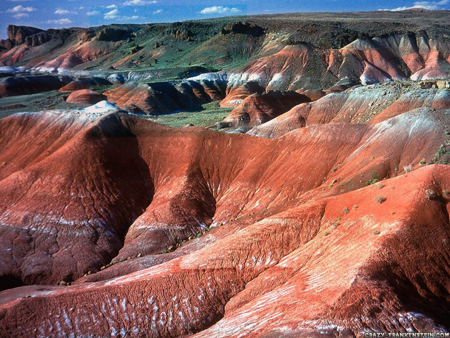
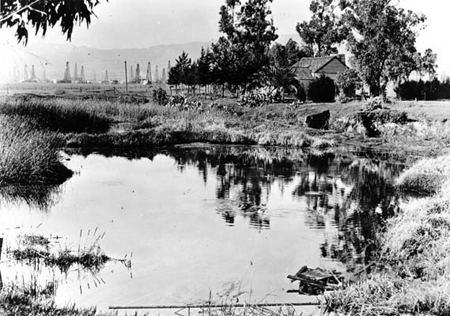
Sante Fe back then was nothing like I imagine it is now, more dusty and sleepy. I remember buying a turquoise and silver ring from an elderly Native American woman selling jewelry on the plaza.  Then when we got to Los Angeles and my father’s boyhood home in Hollywood, he took us to see the La Brea Tar Pits where woolly mammoths, sloths and saber-toothed cats from 38,000 years ago have been preserved in black gook.
 

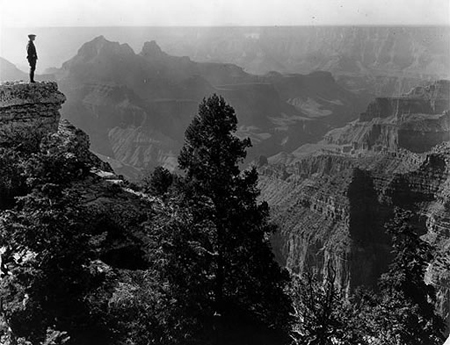
I remember all of it and how stunned I was standing on the edge of the Grand Canyon looking down into the gorge below. It took my breath away and I wanted to dive into the air with joy. It was the beginning of my fear of heights – because they attracted me so much. 

The abandoned little cave dwellings in the Gila Wilderness- that seemed as though you might walk out to make your coffee in the morning and accidentally slide down the edge of a cliff. I remember thinking how physically small the inhabitants must have been. These were tiny abodes even in comparison with West Village apartments.

The final destination for us three kids was of course, Disneyland. It had opened just six years earlier and we were determined to have a blast. 

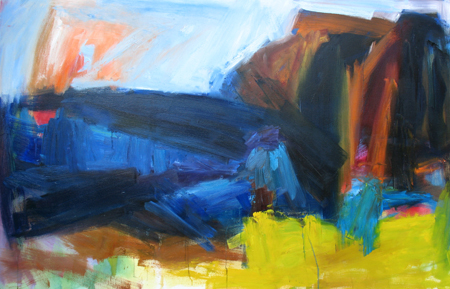
The point that hit home from Burns’ extravagant documentation is that most of my inspiration as a painter has come from nature. I’ve done my share of figurative work and the human form still holds interest. But on many levels, nature is where my work comes from and the paintings demonstrate a deep, direct and emotional response to place. Over the decades, I’ve travelled to many remote, usually mountainous areas on painting trips. The Rockies, Vancouver Island and the northern coasts of California and Oregon have been some favorite regions for more recent solitary exploration and studies.


In my twenties I bought a 40 acre undeveloped paradise in western Maine and planned to create a utopian farm/art studio on top of a mountain facing Mt. Blue State Park. The coast had Acadia, but central Maine had Katahdin in Baxter National Park. The land was sold years ago, but the dream to protect a large swath remains.
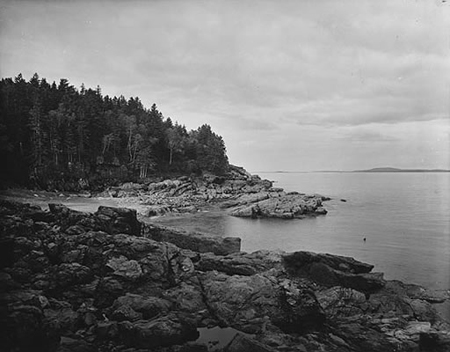
The Great Smokies was one of my favorite areas for mini sketching trips when I lived in Atlanta for twenty years. Mount Mitchell in North Carolina, the Shenandoah National Park in Virginia, I hiked through most of the South’s parks and mountain ranges.

I have to think that the genesis for this highly charged connection can be traced back to that early trip when I was eleven, standing at sunset watching colors seep over the New Mexico desert, or the cerulean blue of an Arizona sky over the Grand Canyon. I plan to dig out my old VHS copies of his 8mm film of that trip and reminisce.

It was moving to see most of the other historians and writers in the series tear up when recalling similar childhood trips with their families to these spectacular monuments.

Thanks, Dad.

…my father was a film editor who worked on the 1945-49 Nuremberg Trials documentary, now in the Library of Congress.
Posted in Daily meanderings, History | Tagged , , , , , , , , , | 3 Comments

Early drawings

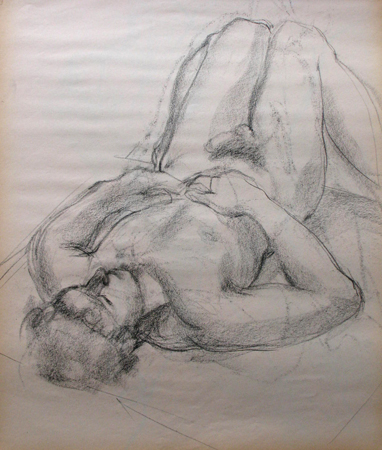
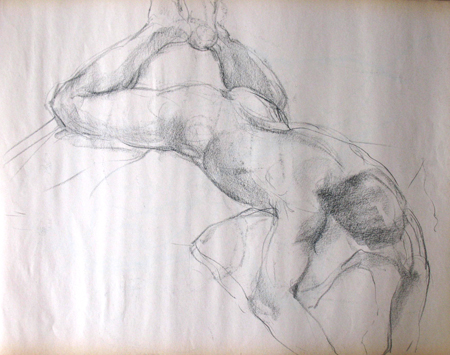
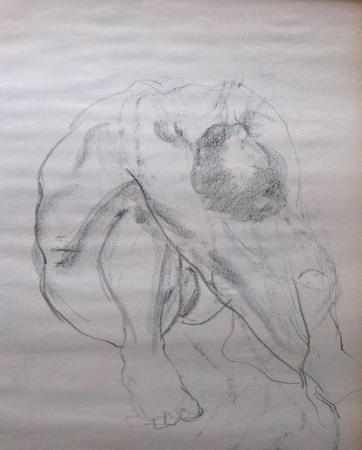
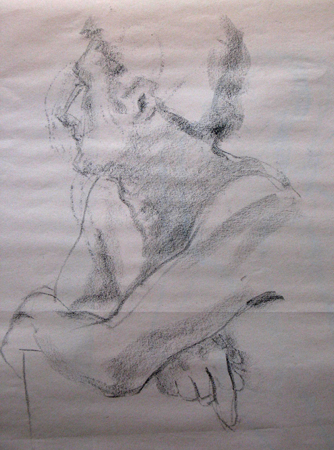
I sold one of my older gestural drawings last week. These were from Chatov Studio classes in Atlanta, that I took from 1981-1988. I’m saving some of them, but newsprint doesn’t hold up well unless it’s framed under glass. Preserving them is the objective.

These are all from one male model who was a performance artist at the time. I painted a couple of oil portraits of him as well. Charcoal or conté crayon on newsprint.

Posted in Daily meanderings, Paintings | Tagged , , , , , , , , | 2 Comments

Living together

Etsy often has wonderful articles on their blog and occasionally post videos of local artists, artisans and unique spaces. This is one of them from the Monterey Bay area. Takes me back.

Posted in Daily meanderings | Tagged , , , , , , | Leave a comment

Fall painting

I haven’t gotten back to this one in a couple of weeks, so it may transform further. Thus, no title as yet. I’ve been consumed with finding a residency in Ireland for next year, getting the house in relatively stable shape for a possible spring sale, and the problems that ownership offers. Like a leaking water heater, overgrown forsythia blocking gutter downpipes and a yard gone wild.

My wonderful Swiss collector has reserved four more paintings, which may be a record sale. ‘Sedum’ a painting from 2005, made it to Sydney, Australia in record time – less than a week. And ‘Medi 1’ is in an exhibit opening in a couple of weeks, ‘A Woman’s Perspective’ at West Chester University.

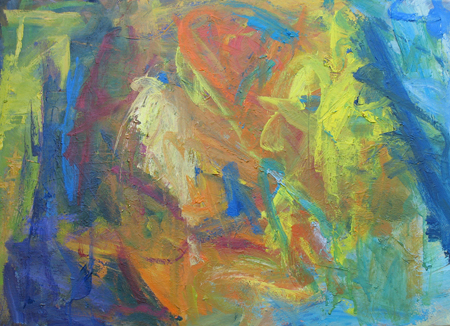
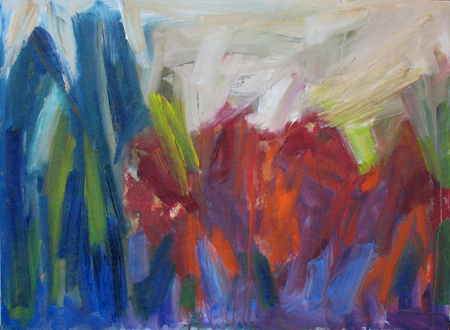
Untitled, oil on canvas 19 3/4″ x 27 1/2″


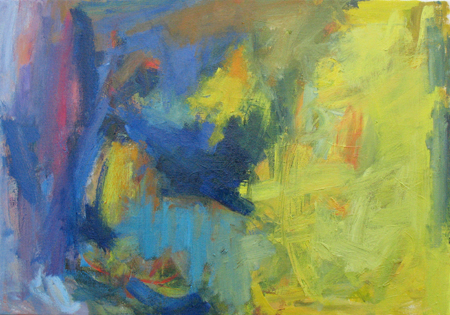
Medi 1, oil on canvas 22″x30″ 2009.


Sedum, oil on canvas panel, 22″x30″  2005

Posted in Daily meanderings, New Work, Paintings | Tagged , , , , , , , , , , | 2 Comments