May

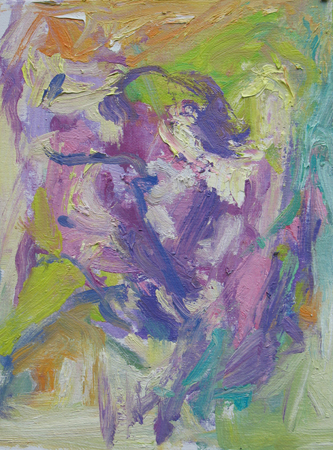
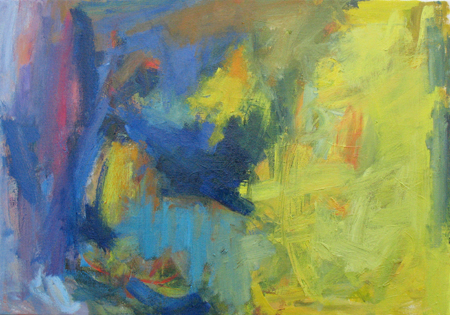
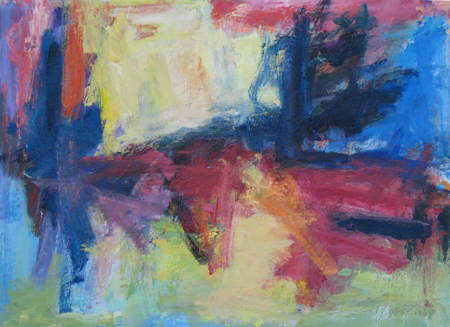
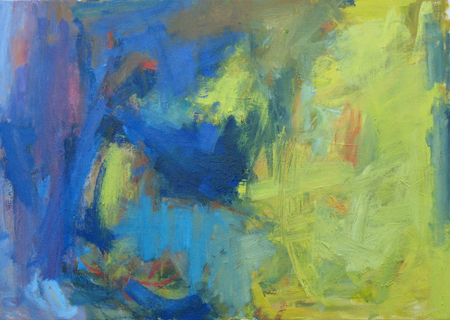
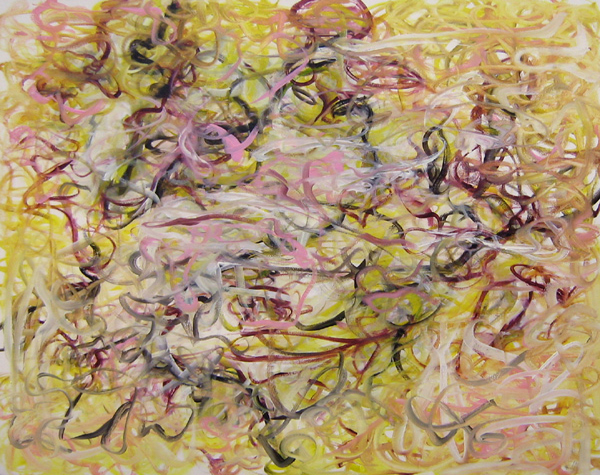
May here in southeastern PA and the Brandywine Valley is an explosion of Pepto-Bismol pinks, lilacs and acid greens. Even with the deluge of rain we’ve had, the trees are blooming and the birds sing their hearts out. I wanted to title this something French, since I’ve been listening to Jacky Terrasson’s ‘A Paris…’, but I restrained myself. 

I’m also featured today on the blog, Spotlight on Handmade.  

May, oil on canvas board 12″x9″ 2009

Posted in Daily meanderings, New Work, Paintings | Tagged , , , , , , , , , | 3 Comments

Interview with Constance Humphries

This is the first in a monthly series of artist interviews.

I met the painter Constance Humphries online at 1000 Markets, where she recently opened a new market called Dialogue, featuring contemporary abstract work. She lives in Asheville, NC and exhibits widely. Visit her blog here.
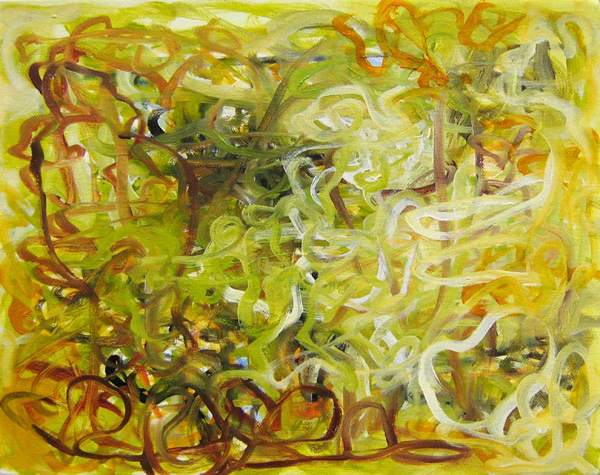
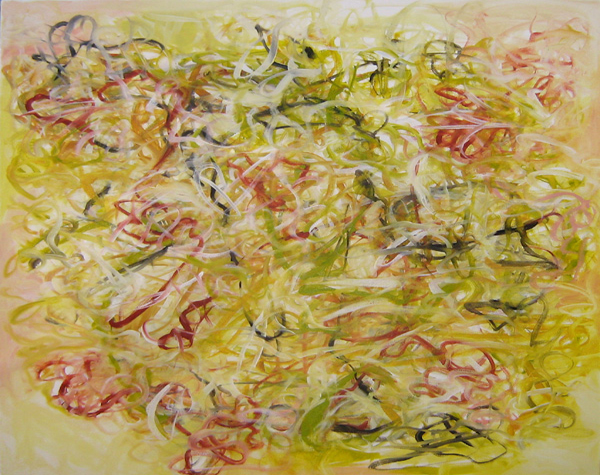
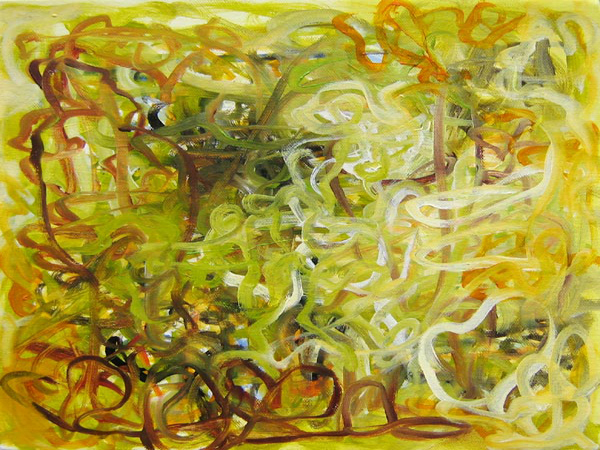
I think you are right     Oil on canvas 12″ x 12″ 2009


fd What does painting mean to you?

As is implied by the question, painting is defined differently for different painters. For me, painting is not the creation of illusion or a means of delivering a message. Instead it is the physical result of my participation in an event that occurs when I interact with a two-dimensional  picture plane in present time. It is about being present, paying attention and creating something that could only exist in that moment. It is endlessly fascinating.

fd Can you discuss your work and thought processes.

Drawing is the primary element in my work. It gives me direct access to my impulses through the immediacy and personal quality of mark-making. The practice of drawing from life loosely informs the actual drawing that comprises the paintings, while conceptually, the work explores life’s inter-dependencies.
The process of creating the work is such that it develops organically. Working intuitively and spontaneously, which allows the subconscious and imagination to take over, each mark suggests others until the work is completed. This is balanced with a slow and careful development of layers that results in a work that is simultaneously formal, random, constrained, loose, deliberate and instinctual. 

fd How would you describe your current series and do you have any ideologies as a painter? What is the context of your work?  

While attempting to avoid labels, groups or affiliations, I suppose the context of this work is a contemporary approach to abstract expressionism. I very much believe in the tenets of that movement and believe that it was interrupted and not fully developed. I have a natural tendency toward improvisation and in finding meaning rather than pronouncing it. I believe truth is found not in thinking but in being present, being in conversation with life. 

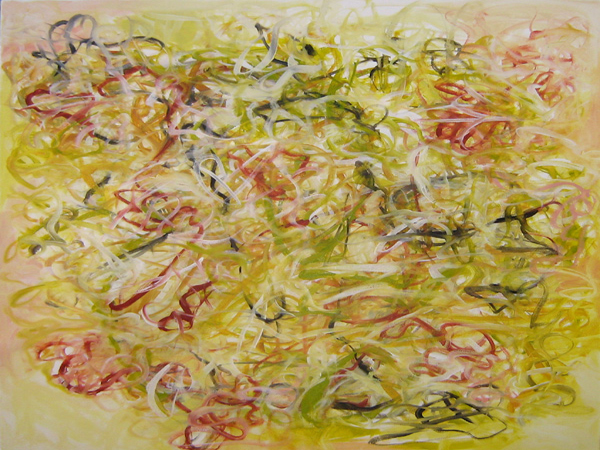
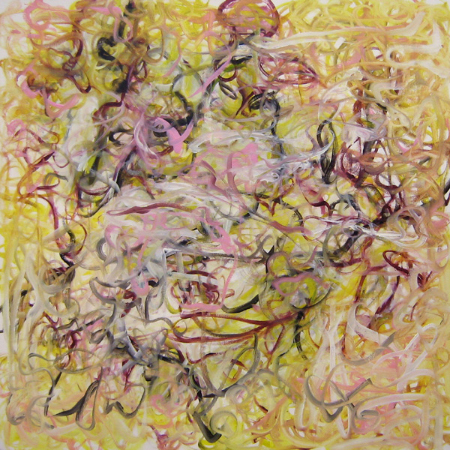
She’s lucky not to have one     Oil on canvas 36″ x 36″ 2009


fd Who are some of your influences, whether they’re painters, sculptors, poets or ‘none of the above’?

 Painters: Cy Twombly, Joan Mitchell, Brice Marden, John Lees Musicians: Hank Mobley, John Coltrane, Miles Davis, Arvo Parte, Philip Glass, John Adams, Steve Reich

fd Do you work spontaneously or is there a set time that you devote to the paintings on a daily/weekly basis?  

I have a set schedule. For me, just as any practice requires discipline, so it is with painting. 

fd Do you visit galleries and museums on a regular basis, or travel to view art and cultural events?   Yes, I visit galleries and museums, go to see/hear jazz and classical music and attend and modern/contemporary dance performances. My travels always include these. I also read art theory and criticism on a regular basis and try to keep up online. 

fd Does networking with other artists and developing community have much bearing on your life as an artist and if so, how does it inform your work and process? 

Many of my friends are artists, musicians or other creative types. I am drawn to them as they are to me out of interest in each others art and processes. For me, it is important to have a network of people who understand why I do what I do, why I work so hard. They understand me and encourage me when I forget what I am doing and give me the opportunity to do the same. However, with regard to my work and my process, other people have little to no bearing.

fd What are some of your long term goals for your painting career?

I want to paint as much as I can. I would love to have the exhibitions, accolades, and sales that come with success, but the painting itself is the most important thing to me, as I don’t know how to be happy without doing it. Painting is a completely integrated part of my life. My approach is to let the career develop as it will. All the career advancements that come my way have done so because of relationships I have built with others out of genuine interest. I am not in some big hurry to get somewhere. I will have the career that I have. I do the things I do in a natural way. I take what comes and don’t try to force outcomes. That’s not to say that I am not proactive as I am very disciplined in my approach. I just know that things will happen without me setting the agenda.
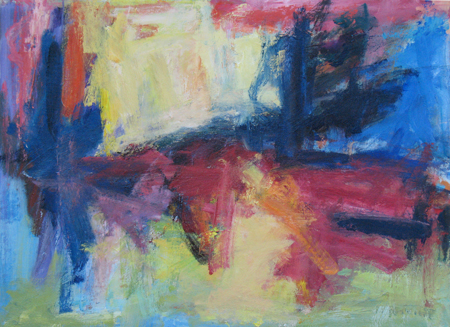
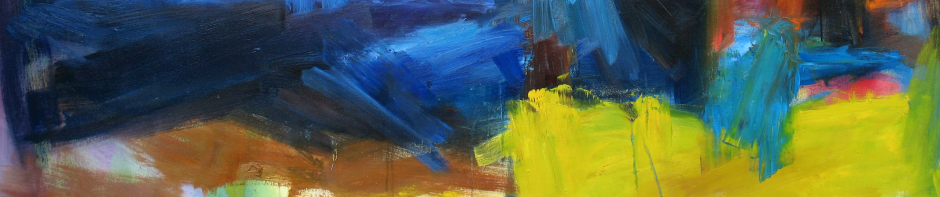
I say boy     Oil on canvas 36″ x 36″ 2009

For more about Humphries’ work, visit her 1000 Markets shop here. Web: http://www.constancehumphries.com Blog: http://www.steplikeagiant.com Twitter: http://twitter.com/constanceh LinkedIn: http://www.linkedin.com/in/constancehumphries
Posted in Interviews | Tagged , , , , , , , | 2 Comments

Apple Tree in bloom

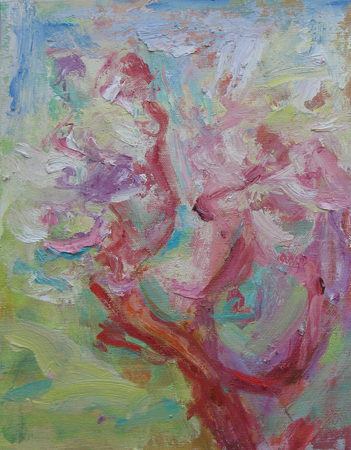
Everything outside is pink, white and acid green. I planted two apple trees 3 years ago and the Liberty has done well. I hope to get at least a dozen apples this year. In bloom, it’s like a new baby. 

Apple Tree, oil on canvas board, 14″x11″ 2009

Posted in Daily meanderings, New Work, Paintings, Shop | Tagged , , , , , , , , , | 1 Comment

UCTV – Philip Glass in conversation

UCTV out of Berkeley, CA has some of the best cultural programming you’ll find on television.
Here’s a wonderful hour talk with the composer Philip Glass and the music critic Tim Page. In the mid ’60’s Glass studied in Paris with my own piano teacher’s famous teacher, Nadia Boulanger. She evidently never revealed what she thought of his work.

Glass talks about his operas based on his early interest in science, about all music being ethnic, the origin of the cello and other fascinating music esoterica. His notes about Kepler’s predictions based on astrology are hilarious, but you’ll have to watch the whole clip before he gets to it.

Philip Glass in Conversation, UCTV

Posted in Daily meanderings, Music | Tagged , , , , , , , , | 1 Comment

New painting and Verlaine

My friend Phil, who lives outside Paris with his lovely wife Sally- and is a savant about art, poetry and music – said that my newest work reminded him of a Verlaine poem. Now knowing that Paul Verlaine was one of those flowery Symbolists, I wasn’t quite sure how to react. But after thinking it over and doing a little research on Mr. V, I discovered some of his poetry set to Claude Debussy’s music. A favorite composer, Debussy’s transition to his unique mature style emerged with these poems put to his notes. Voilà, a title for my painting.

Then too, in the spirit of Earth Day, this is a recycled work. Inspiration is from the huge tulip magnolia in my front yard, that drops all its pink petals almost as soon as they’ve bloomed. 

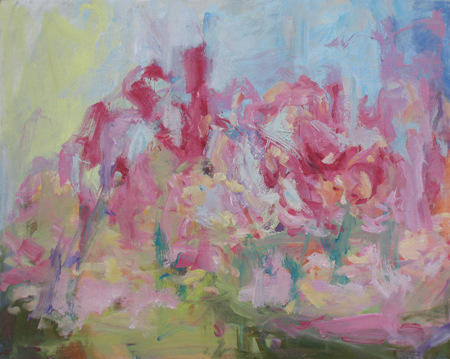
Ariettes Oublieés, oil on canvas 24″x30″ 2009

from ‘All Music Guide’: The music is highly chromatic and tonally ambiguous, traits that Debussy would make his own in the next few years. Also, Debussy begins to make heavy use of the dominant ninth chord, one of his later trademarks; indeed, the very beginning of the first song is a series of falling ninths.

Debussy set Verlaine’s poetry 19 times through his career; the texts are rich in long, lazy vowels and seductively repetitive consonants. The first item in Ariettes oubliées is typical of Verlaine’s work and a highly adept musical setting by Debussy: the gauzy, floating melodic line perfectly reflects the text of C’est l’extase langoureuse, in all its languorous ecstasy. 

From Erik Reischl: Paul Verlaine’s “Romances sans paroles” is a collection of poems written in 1874 during the vagabond period of his life which he shared with the poet Jean-Arthur Rimbaud. Symbolism influences the greater part of his work and is obvious here for the first time. Words become music, become tones and colours in the finest nuances and shades. In January 1885 Debussy began to write music for two of the poems after having been inspired by the musical quality of Verlaine’s poetry.

After winning the “Grand Prix de Rome” for his cantata “L’Enfant prodigue”, the young composer went to Rome only days later, where he was to remain for three years in the Villa Medici.

The separation from Madame Vasnier for whom he had written nearly all of his songs and the absence from his beloved city Paris were hard to bear. It is probable that the last four songs of the collection, written between 1885 and 1888, were to be a present for Madame Vanier when he returned.

The songs were originally published individually in 1888 under the title “Ariettes”. Debussy sent Mme Vasnier a copy of the first publication with a handwritten dedication. However he made a final dedication in the second publication which appeared as a complete collection in 1903 in a revised form and titled “Ariettes oubliées”. On this occasion the recipient of the dedication was the soprano Miss Mary Garden, who had taken the role of Mélisande in the premiere of Debussy’s opera “Pelléas et Mélisande”.

For the first time Ariettes oubliées adhered closely to the format of the poetry. There is no longer a repetition of texts found in the early Vasnier songs. The melismatic style gives way almost completely to a composing in which every syllable is represented by a note. Even the formal structure of Debussy’s songs adheres in its construction and content to each of the poems. This creates in “Il pleure dans mon coeur”, for example, a remarkable imbalance of the individual parts due to the thought processes in the text. Quite often Debussy focuses on important parts of the text by using recitative techniques (“Quoi! nulle trahison?”), or by voicing a whole sentence on a single tone (at the beginning of “Spleen”).

Debussy lets music serve the word and through this he is able to achieve a musical analogy to Verlaine’s postulate.


My old teacher and a concert pianist himself, Constantin Chatov, used to insist that all music was about sorrow, ecstasy and sex.

Posted in Daily meanderings, New Work, Paintings, Shop | Tagged , , , , , , , , , , , , , | 3 Comments

North Slope Farm – SAITA Soil Structure Workshop

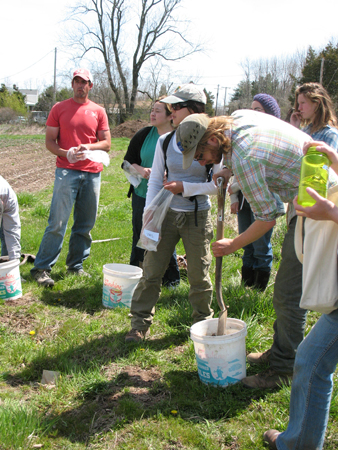
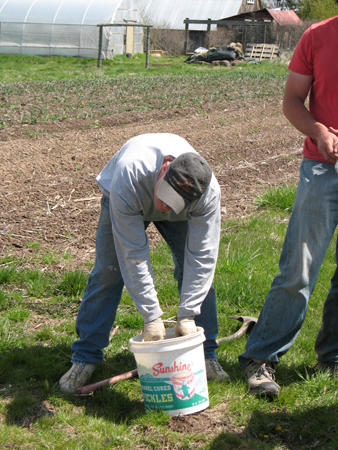
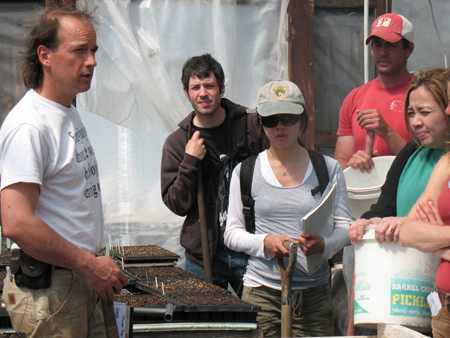
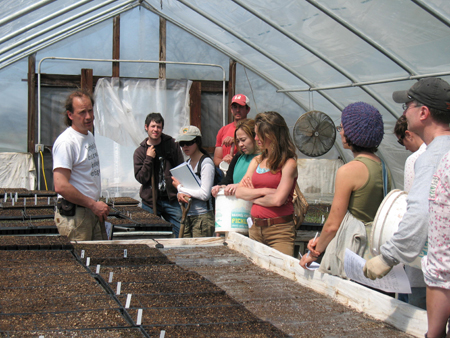
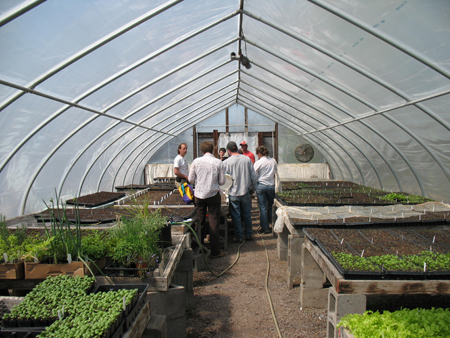
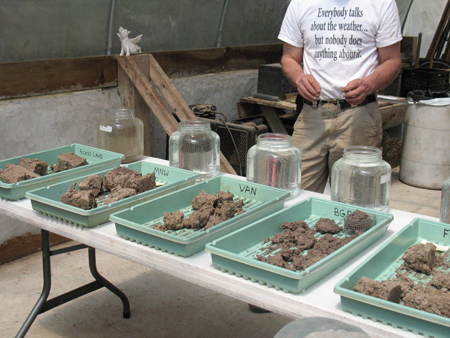
We had a great turnout of interns from Blooming Glen and Sankanac Farms and one interested future farmer for our first SAITA workshop at North Slope in Lambertville, NJ. The farmer and owner, Mike Rassweiler, was well prepared with handouts and a soil testing exercise on his 50 Acre farm in central NJ. Check his website for great information on fertilizing and his Flickr pages for his examples of profits and loss from his farm over the years. His greenhouses were full of baby greens, bright young basil and had some of the tiniest cell flats I’ve ever seen. 

He’s been farming this property since 1994 and lives there with his wife Colleen and baby Casey. They offer housing and a 3 year training program to interns and currently have about four people helping out. . A good lab to get your samples analyzed is A & L Eastern Labs in Richmond, VA. I had my own Atlanta garden soil sampled there about 15 years ago.

Not so great video from my little Canon, but worth viewing for Mike’s notes on soil. Watch it here.

Mike is aiming for no till on all the beds and uses ‘living’ shoulders between rows. He cover crops at the end of the season, and uses compost annually on most beds. Since one of his specialties is salad or field mix, he prefers to avoid cross contamination by not using any animal manure. He buys mushroom soil, and has used municipal deliveries of leaf waste in the past, from which he was getting a tipping fee. He does buy some organic fertilizer from Fertrell.

His main 3 acres is bounded by an electric fence for deer, a challenge is erosion and drainage; loss has occurred during heavy rains.

These are shots from the day.

soil sampling-


greenhouse-


water test-


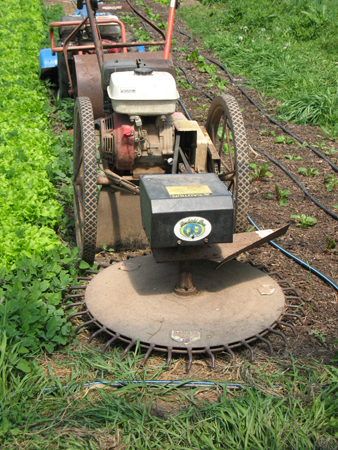
the Bachtold mower-

Posted in Daily meanderings, Local Farms | Tagged , , , , , , , , | 1 Comment

Painting to Mary Lou Williams, watching Marshall Ganz

This was once a failed painting, obliterated and now returned to life. Inspiration is spring and Atlanta born Mary Lou Williams’ 1974 ‘Zoning’ CD, on which are two pieces from her ‘Music for Peace’ mass, later called ‘Mary Lou’s Mass’. She’s a jazz pianist to rival none.

Medi I, homage to ML Williams. Oil on canvas 22″x30″.

MediI


Grit TV offered a Skype clip tonight featuring activist and public policy lecturer Marshall Ganz talking about community organizing and the politics of hope. In the spirit of Saul Alinsky, Ganz notes how marketing strategies over the past 40 years have replaced organizing strategies, rather than people mobilizing and linking together for a common cause. At least up until recently. He mentions transformational vision as the function of criticality, an understanding of the world’s pain, but also of hope and a vision of the world’s potential.

‘The politics of hope are much more demanding; they require development of our imaginative skills, taking responsibility and looking for opportunity and taking risks to act. That’s the environment we’re in right now.  ….We are in a fast moment now’.

GritTV courtesy of MeFeedia

Posted in Daily meanderings, New Work, Paintings | Tagged , , , , , , , , , , , , , , , , | Leave a comment

April weather

While the south was having tornadoes, we had our first thunderstorm last week. Always inspiring. Spring is bringing with its new blooms a burst of creativity. 

Storm over Lancaster Avenue, 16″x20″, canvas on board

Posted in Daily meanderings, New Work, Paintings | Tagged , , , , , , , , | 2 Comments

New work

I’ve been wanting to do more large abstracts after many months of smaller works. Here’s the latest. 

April 22″x30″ oil on canvas board

I’m reading Irving Sandler’s 1970 ‘The Triumph of American Painting, a History of Abstract Expressionism’, in which he tells us about artists who took jobs with the Federal Art Project, a spin-off of the WPA. DeKooning was doing odd jobs to get by and this program enabled him to explore his own work full-time after 1936. The gov’t gave about 5,500 artists, craftsmen, researchers, photographers and teachers monthly average stipends of $95 to do whatever they wanted. All they had to do was produce 96hrs of work. The book goes into detail about the plight of the artist during the mid 1930’s. They were thrown together by ‘mutual distress and artist organizations began to form as a natural result’.

Without government assistance these artists might not have created Abstract Expressionism. Another interesting shift was that the Great Depression ‘upgraded the social standing of artists….after the collapse of the economy, artists could shake their feelings of social inadequacy, for the American Dream was proven bankrupt.’  I think we could say the time has come for the arts to take center stage again, but the administration is going to have a hard time convincing angry Americans to throw money at struggling artists, galleries and museums.

Posted in Daily meanderings, New Work, Paintings | Tagged , , , , , | 2 Comments

The owls of spring

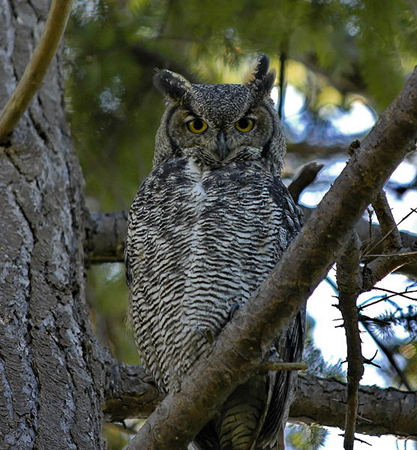
So a couple of nights ago two Great Horned Owls were hooting at each other in the wild bramble of trees and border along the edge of my backyard, and woke me up. It’s the kind of noise that somehow always makes me not only happy, but ecstatic to be hearing a part of nature that so rarely presents itself in suburbia. And it means it’s spring. 

When I lived in Nova Scotia, my ex and I would go on long hikes back into the woods. One hike brought us to a lake that hadn’t been deadened by all the logging in the area. A female moose was quietly eating from it as we came upon the opening in the thick fir forest. We surprised a porcupine, who slowly waddled out of our way, but the most amazing encounter was a huge horned owl who sat on a tree limb and watched us as we made our way out of the woods at dusk. She didn’t budge – just blinked. The females are larger than the males and this one was big. We kept turning around thinking that she’d fly off. Nope, she wasn’t moving from her spot. Take a listen. Magnificent creatures.

A pair of Great Horned owls 


A month or so back, in late February, I heard the foxes again too.

Foxes
Continue reading

Posted in Daily meanderings | Tagged , , | Leave a comment