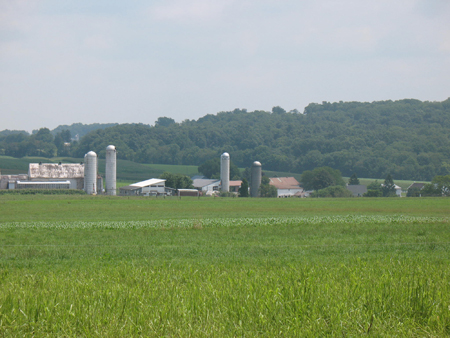
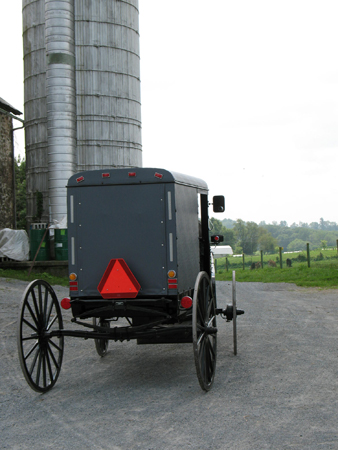
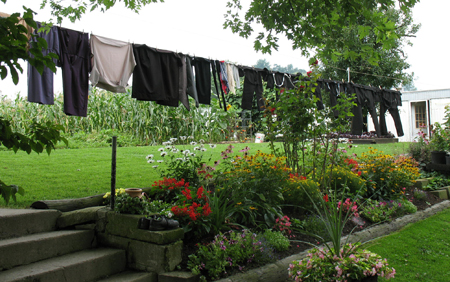
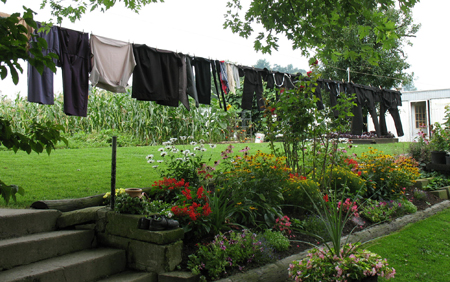
I spent the morning and early afternoon at an Amish farm in Honeybrook, PA, which should be 25 minutes from me, but ended up being a 40 minute circular goose chase. I found the place with no help from Google or Mapquest, after first stopping to ask a gas station attendant, and finally an Amish youth pedaling a scooter down the road came to the rescue, turned out he knew the farmer. In western Chester County, the region feels more like Lancaster from the good sized smattering of Mennonite and Amish farms.
This was another workshop for farm interns/apprentices and the general public, that I coordinate for Maysie’s farm. What you may know about the Amish is that they don’t use electricity or drive cars. What you probably don’t know is how organized and savvy they are about farming. Why all the kids? To help farm the land. And these are polite, well mannered teenagers who dish out ice cream to strangers without attitude or any twinge of resentment for being made to work on a Saturday. I am duly impressed.Â
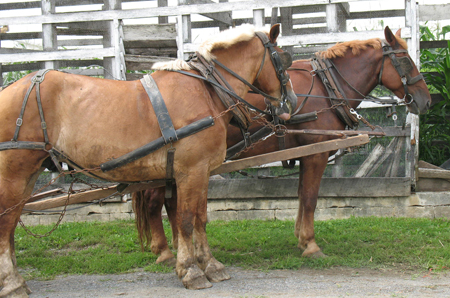
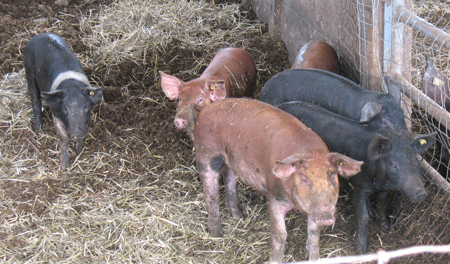
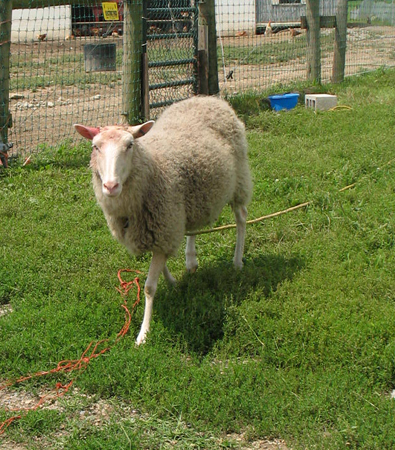
Benuel Stoltzfus and his wife Anna, along with their nine children, raise dairy cows, chickens, pigs, and offer organic raw milk, grass fed beef, cottage cheese, yogurt and various other hard cheeses as organic value added products from their farm. After a horse drawn wagon farm tour around the fields to visit the Jersey girls, we were treated to delectable homemade vanilla and chocolate ice cream.Â
I came away loaded with fresh – oh the yellow! – organic butter, glass bottled milk with cream settled at the top, organic yogurt with a stripe of cream near its lid, free range eggs and handmade soaps. Rose geranium and rosemary lavender. I got to see the hens scratching and new 6 day old piglets. Maybe that’s why I forgot to buy any bacon.
I’ll have more information available about the farm and its practices on Maysie’s blog tomorrow.
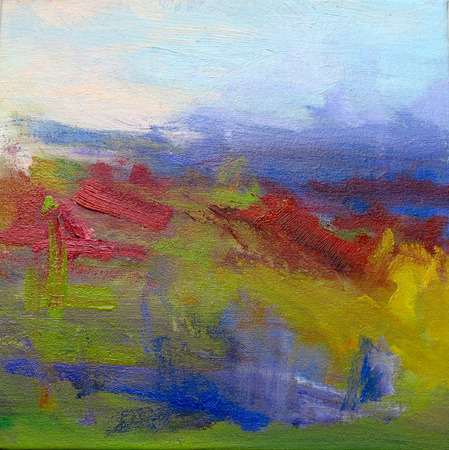
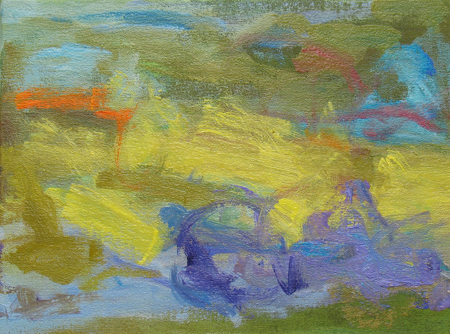
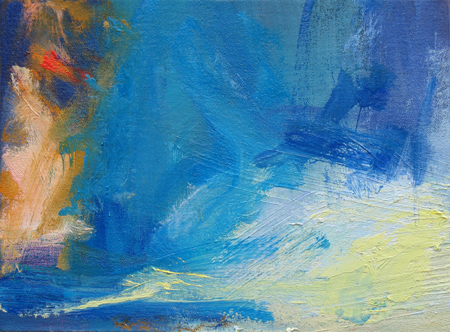
I’ve been going out to local farms for an internship program I coordinate and am always struck by the abundance of food and produce. So this painting has some basis in the concept of fruitful fields.
I also listen to jazz or classical music while I paint and this was conceived while listening to ‘Smile’ by Brad Mehldau from his 2004 ‘Anything Goes’ CD.
Originally written by Charlie Chaplin in 1936 for his film Modern Times, this song has become a popular standard. Mehldau interprets the ‘spiritual breakthrough’ that Chaplin wrote about during the depression, but it’s never sappy or maudlin.
Â
Fields of Plenty (or Smile), 12″x12″ oil on canvas panel 2009
I’ve written about Lloyd Kahn’s blog before, and thought I’d offer a few gems from his own collection of handmade houses and spaces, across the world. Kahn is the founding editor-in-chief of Shelter Publications and former shelter editor for the Whole Earth Catalog. His blog features eclectic and unusual living spaces, for both humans and animals. They are truly works of art, harmonious in their natural environments.
Take a look. His notes of explanation.
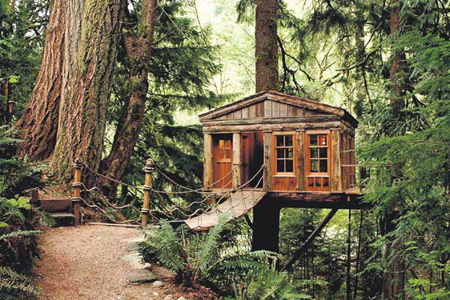
A Washington state treehouse called ‘Temple of the Blue Moon’, built by author and treehouse enthusiast Peter Nelson. It is part of Treehouse Point, a Snoqualmie Valley retreat.
Â
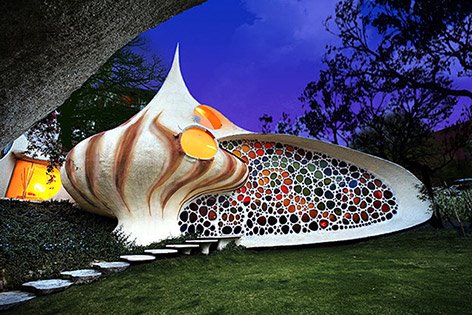
Sculptural Ferro-Cement Seashell House in Mexico City. Designed by Senosiain Arquitectos.
Â
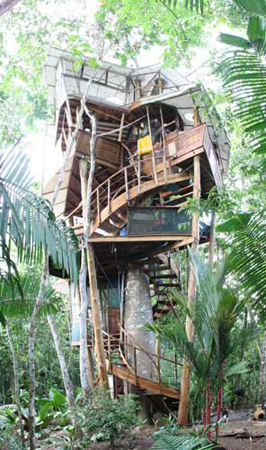
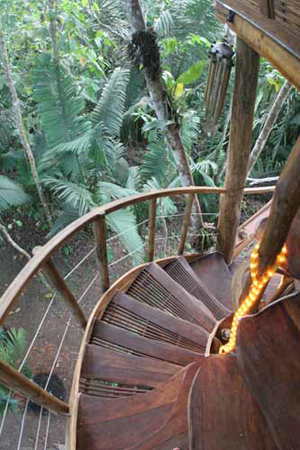
Michael Cranford’s treehouse is not attached to the central tree, but is supported by 40′ posts. It’s on the edge of a tropical jungle reserve. Â
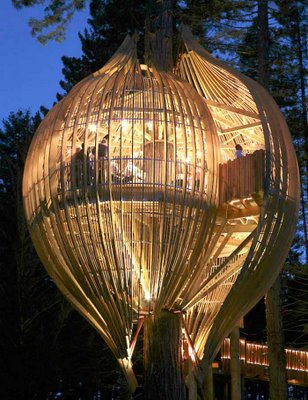
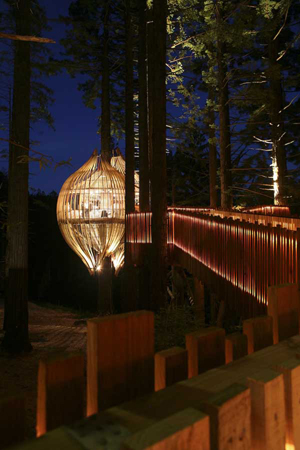
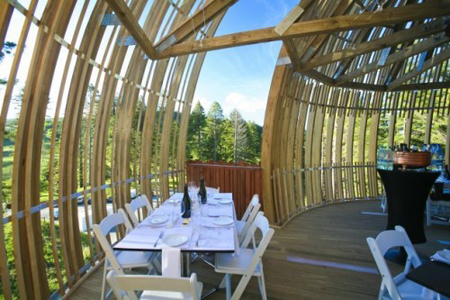
A treehouse restaurant called Yellow Treehouse, north of Auckland, New Zealand.Â
Â
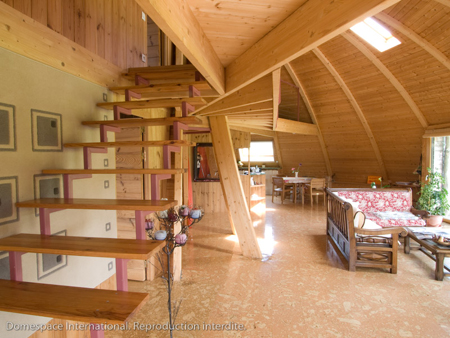
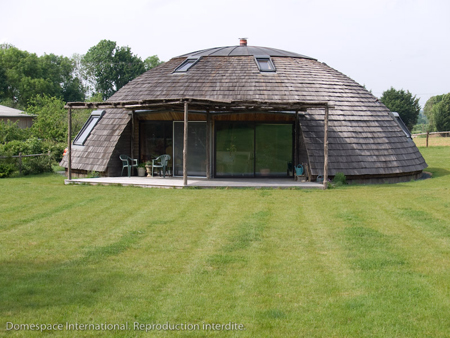
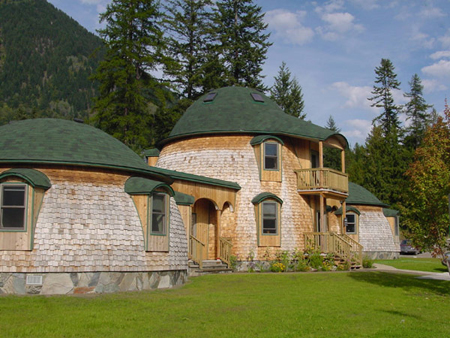
Prefabricated modular wooden dome village in Canada. Vancouver company.
Â
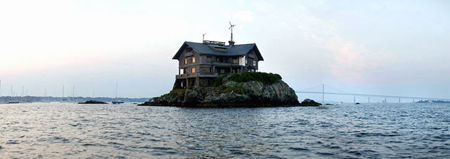
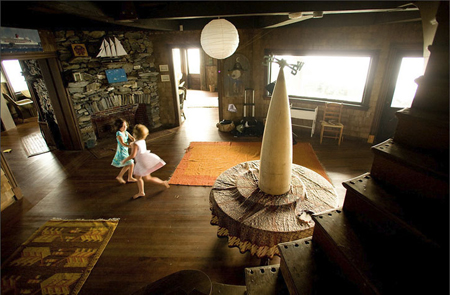
Clingstone, an unusual, 103-year-old mansion in Rhode Island’s Narragansett Bay, survives through the love and hard work of family and friends.
Â
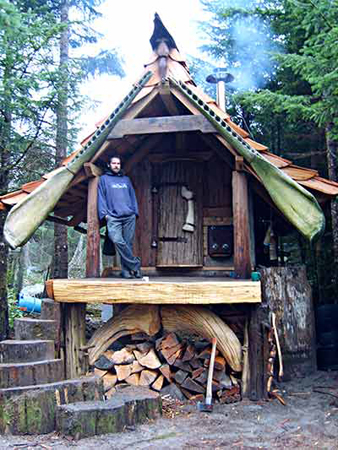
and my favorite sauna of all time – ‘Some photos of this unique little sauna by Colin Doane on Haida Gwaii (First Nations’ name for were the Queen Charlotte Islands)…. Looks like whalebone rafters in front.’
Â
Last one is for your chickens. This little chicken coop has 3 nests and is suitable for 6-8 chickens. It’s fully assembled and costs $1295 in the east and $1895 in the west. (You can also build it yrslf.) Made by Horizon Structures in Atglen, PA.
I first saw ‘The Boy with Green Hair’as a child and it impressed me for its individualist and political stance. Where I grew up, conformity was not especially the norm, but diversity of ethnicities and intellectualism was. So the kid wakes up one day with green hair, it wasn’t the tragedy of being left an orphan from war. ‘The realization about his parents and the work helping the orphans makes Peter turn very serious, and he is further troubled when he overhears the adults around him talking about the world preparing for another war.’
Joseph Losey was a brilliant ‘filmmaker in exile’ for most of his long career. He was a target for the House Un-American Activities Committee and fled to London to pursue his work in peace. This film was one of his more idealistic and fantastical pieces critiquing governmental (American, Russian, British, French and Chines) policies, ‘couched in terms of fantasy and fable.’Â
The writer Dan Callahan aptly describes the film’s main arc:Â
‘The Boy with Green Hair was an allegory about war and intolerance produced by Dore Schary, a cornball fellow who liked to make little “message†pictures. Many of Schary’s other productions have dated, but The Boy with Green Hair survives well, though it takes a bit too much on its shoulders. It’s an extreme attack on conformity, staunchly anti-war and anti-nuclear. Whilst Fritz Lang undoubtedly influenced his handling of mob scenes, Losey differs from Lang in his volatile identification with his characters. The scene that sticks in this respectable debut is the one where Dean Stockwell, such a touchingly serious child, is forced to give up his individuality, his green hair, in order to please the people of the small town he lives in. Though restrained, the scene is almost tragic, and Losey puts all of his energy behind it. Already he was showing his talent for emotional collisions that cut to the bone without caution.’
Another tour de force on individuality, Joyce Cary depicted his character Gulley Jimson in The Horse’s Mouth, as an anarchist, drawing on ‘pre-war bohemian life, and is notably sharp on the mundane realities of survival on the breadline, in the vein of Orwell’s social reportage.’ In fact, George Orwell recommended Cary’s earlier novels to the ‘Liberal Book Club’. Cary’s themes in most of his books centered on freedom and liberty, qualities being threatened during WWII.
Directed by Ronald Neame, Alec Guinness portrays the lead character Jimson, loosely patterned by Cary after his friend the poet Dylan Thomas.  Guinness constructs a prankster’s paradise for a wily painter who resorts to subterfuge and lies to feed his obsession; art as life. I read the book after seeing the film in the early 80’s and it remains a favorite, for both laughs and inspiration.
Â
Bruce Eder, from a 2002 Criterion review:
‘Here, unusually, the paintings really do matter. They’re not copies of well-known classics, as in most artist biopics—they were executed by John Bratby, a leading member of the group of English provincial realists who came to be known, rather unfortunately, as the “Kitchen Sink†school. In truth, Bratby would be better described as an expressionist, in view of his vigorous sculpting of paint, even if his preferred subject matter was often domestic. But in The Horse’s Mouth he lends his talent to the tradition of English artists, from William Blake to Stanley Spencer, who wanted to connect the visionary with the vulgar; this is surely what Bratby, Neame, and Guinness do magnificently in the film’s moments of epiphany. Gulley contemplating his sinewy impasto foot by candlelight, or first seeing the wall that will bear his mural masterpiece—these are rare moments when we actually feel something of the artist’s imagination. And in terms of the film’s prescience it is worth noting that Bratby temporarily gave up painting and wrote a novel called ‘Breakdown’ in 1960, because his work had become unfashionable as American Abstract Expressionism swept the world. It’s tempting to feel that life here was imitating art.’
Brad Leithauser says: ‘His is not the calculated stoicism or liberated detachment of the born philosopher. Rather, it’s the sangfroid of someone who must check his emotions because their fervor continually threatens to undo him. Gulley is forever having to squelch his rage. His is the simmering calm of a man who feels a fire roaring underneath him.Â
… it seems the one burning hottest and longest is a conviction that he is destined, as an uncompromisingly innovative artist, to remain an unappreciated soul in his lifetime. Although he shrugs off his neglect with a witty mordancy (“Walls have been my salvation…. Walls and losing my teeth young, which prevented me from biting bus conductors and other idealistsâ€), he carries within him, as he wanders the streets of London, an affronted notion of his own civic inconsequence.
Joyce Cary once wrote of his most famous creation, “Jimson, as an original artist, is always going over the top into No Man’s Land, and knows that he will probably get nothing for his pains and enterprise but a bee-swarm of bullets, death in frustration, and an unmarked grave. He makes a joke of life because he dare not take it seriously.’
Â
The Criterion Collection, an offshoot of Janus Films, Â distributes consumer versions of classic and contemporary films.
According to Velázquez, she was inspired by an aria from the Spanish 1916 opera ‘Goyescas’ by Enrique Granados.Â
One of the finest bass players in the world, I had the privilege of seeing Jim Hall at the Monterey Jazz Festival in 1997. As a teenager, I played Granados’ incredibly romantic music on the piano.
The gardens are thriving with all the rain we had this spring and early summer. It’s also been temperate for this time of year, dropping into the 60’s at night. Very few pests and I attribute that to my swaths of ‘meadow’ – grass that I let go long. I noticed families of bats flitting back and forth over the gardens at dusk, ladybugs on various plants in the daytime, and hundreds of fireflies. The firefly babies are the carnivores who eat the bad guys in early spring.
Sadly, my township ordinance doesn’t allow free standing meadows ‘within 300 feet of residencies’, so I was forced to trim the biggest area visible to the neighbors who tattled on me. I did rebel and leave an area long, to the far side of garden. These township ordinances need to be rethought, as many of the traditional pests – mosquitoes, aphids, cabbage worms- could be prevented through simple measures like allowing hedgerows and wild areas for overwintering insects, birds and toads. More farmers and gardeners across the country are returning to methods used for generations before pesticides were invented.
I planted my lettuces, arugula, radicchio, sorrel and dandelions very closely together. They’ve been providing wonderful salads since late May. These are a mix from Johnny’s Selected Seeds in Maine (I’ve been buying from them since the 1970’s!) and Jung Seeds in Wisconsin.
Â
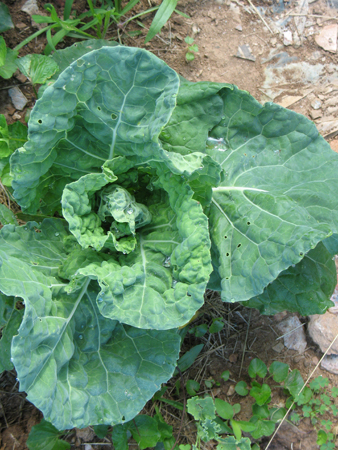
I have never been able to grow cabbage like this- coleslaw with homegrown apples coming soon…
Â
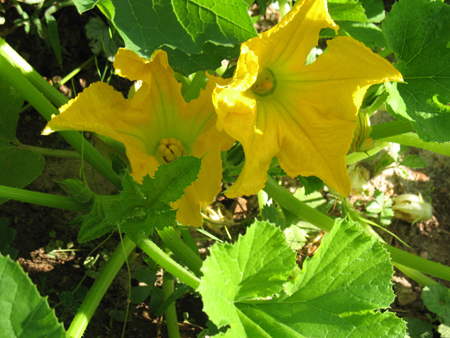
The zucchini looks healthy too, no vine borers….yet.
Â
A small plot of Silver Queen corn should offer some tasty eating come late July or August.
Â
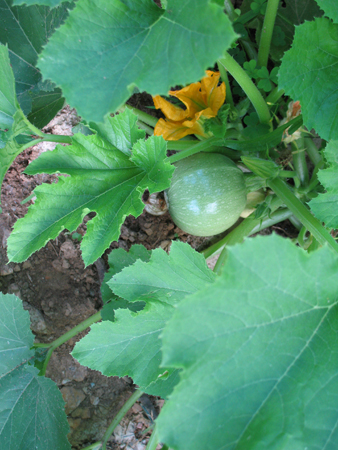
This is a baby winter squash called ‘Sunshine’ from Johnny’s. It’s a scarlet fruited Kabocha type hybrid developed in 2004, that rated highly in trials throughout the US and Canada. I hope to be making a fall pie from the few that I have dotted around the gardens.
Â
Monarda attracts bees and butterflies and smells and looks lovely in the garden. I got my native versions from Redbud Nurseries in Glen Mills, PA.
Â
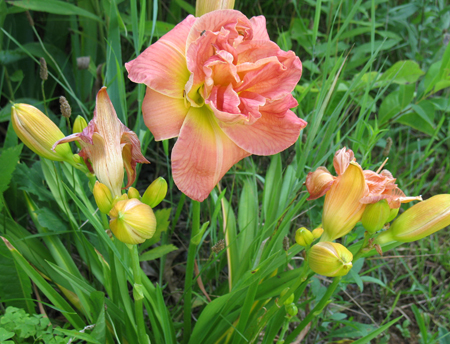
These are beautiful and unique lilies that I bought from the Delaware Valley Daylily Society at a church garden sale in Paoli a few years ago.Â
I also had some good press for my  SAITA coordinating efforts for Maysie’s Farm. Red Flag Media publishes GRID, a free Philly magazine that is also readable in a cool netbook online. Pg 6 is where they highlighted the workshop series. The Philly Inquirer has graciously been putting us into their weekly gardening calendar and Lancaster Farming also has the workshops listed in their event calendar.
And the Chester County Buy Fresh, Buy Local Food Guide is finally published- pdf format available at the link. Some of my photos from the ’08 farm tour are in the guide. Nicely done with help from various local groups, including the CCPlanning Commission.
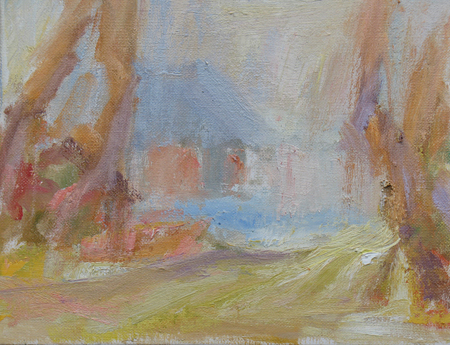
…a couple more small paintings from the same series. I have so many fireflies in my yard that it’s magical out there during the evenings. Will have to try to get pics.
Both are 9″x12″, available either here (my EShop) or in my Etsy and 1000 Markets shops.
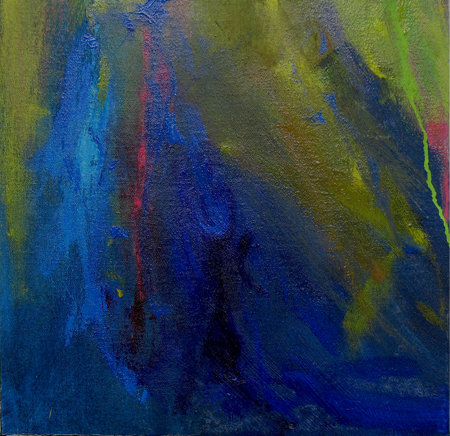
New small paintings from the last couple of weeks. I made the panels myself by cutting up masonite and attaching the canvas. I much prefer this type of panel over the versions I’d been using, simply because they’re a little more rigid and sturdy.
These all derive from a much larger painting that was scarred beyond repair, from my relocations for jobs, back and forth across the country. I find it liberating to paint over the original work, and the previous color and composition inform much of the new paintings.Â
All are 9″x12″, available either here (my EShop) or in my Etsy and 1000 Markets shops.
Two pop icons died today. One updated Astaire’s (and Kelly’s) moves, followed PT Barnum’s model for showbiz and blazed through the ’70’s and 80’s. The other was known for her hair more than her acting. I listened to part of a newscast about Michael Jackson and while the claim was that he broke the racial barrier in music in modern times, that’s a bit overstated. Ray Charles refused to play to segregated audiences in the 1950’s in Augusta, GA and was sued by the promoter.Â
“I told the promoter that I didn’t mind segregation, except that he had it backwards. . . After all, I was black and it only made sense to have the black folk close to me. . . Let him sue. I wasn’t going to play. And I didn’t. And he sued. And I lost.”Â
…in Jackson’s honor I give you Mr. A in ‘Say it With Firecrackers’.Â
youtube disabled the embedded video- watch it here.
Sharon Butler’s Two Coats of Paint is a blog I follow and she always has interesting posts. Today in a guest blog post on Art21 she wrote about Mel Bochner‘s new book, ‘Solar System and Rest Rooms: Writings and Interviews, 1965-2007’. Out of work as a young artist in 1965, he was paid $2.50 per review by Arts Magazine for about $30 each month, earning his rent at the time.
An excerpt from the book:
Competency, craftsmanship, and professionalism lend these large painting-constructions a certain interest. Into shallow spaces constructed behind a heavily surfaced canvas, small wooden abstract shapes are placed in the manner of meticulous Nevelson. The keyed-down color, non-referential shapes, and small esoteric numerals and arrows do not quite achieve an intended aura of mystery. If Bonevardi aspires to enigma, his all-too-familiar international vocabulary is incapable of expressing it.
Butler goes on to say that Bonevardi did well despite Bochner’s review and his work resides in collections at MOMA and the Guggenheim.
Â
Blogging for the mortgage payment isn’t a bad idea.